每 (měi) means "Every / Each" in Chinese. It has 7 strokes with the radical 母, and is HSK Level 3.
Rated 3.5/5 in difficulty (challenging).
Harder than 43% of HSK Level 3 characters.
Appears in 3+ common words including 每天 (měi tiān), 每个 (měi gè), 每次 (měi cì).
Due to its 7 strokes, Hanzi Writer's error detection shows 每 requires focused practice — most learners need 10+ attempts for consistent accuracy.
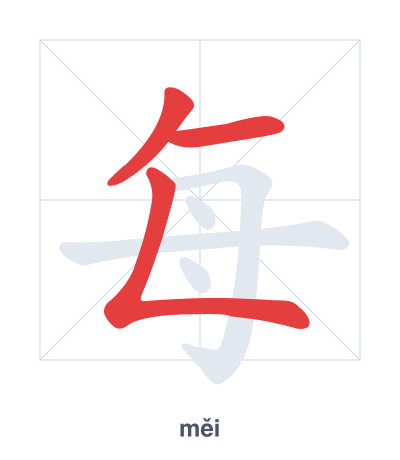
Open Hanzi Writer to see the animated stroke order and practice writing 每 with real-time feedback.
The character 每 (měi) is written with 7 strokes. Follow the standard Chinese stroke order: top to bottom, left to right, outside before inside. The radical 母 is one of its key components.
Practice the correct stroke order with the Hanzi Writer app to see animated stroke-by-stroke guidance with real-time feedback.
每 means Every / Each.
As an HSK Level 3 character, 每 is an intermediate-level character.
每 originally depicted a woman with a hairpin, derived from 母 (mother) with an added stroke representing a headdress. This image of an adorned mother came to symbolize 'every' or 'each' individual. The character combines the radical 母 (mother) with a top stroke to emphasize each unique person.
💡 Memory Tip: Imagine a mother (母) wearing a tall hat (the extra stroke on top) to remind you that 'every' mother is unique.
我每天都学汉语。
wǒ měi tiān dōu xué hàn yǔ
I study Chinese every day.
每个学生都有一本书。
měi gè xué shēng dōu yǒu yī běn shū
Every student has a book.
每次他都迟到。
měi cì tā dōu chí dào
He is late every time.
Open Hanzi Writer to see the animated stroke order and practice writing 每 with real-time feedback.
✨ Animated stroke order · Handwriting recognition · HSK-graded practice · Free to use
The top part of 每 resembles a person (人), and the bottom part is the radical 母 (mother). Together, they suggest "every person has a mother," which connects to the meaning of "every" or "each." This structural analysis is a common way to remember the character.