纫 (rèn) means "To thread (a needle)" in Chinese. It has 6 strokes with the radical 纟.
Rated 3.2/5 in difficulty (challenging).
Appears in 3+ common words including 缝纫 (féng rèn), 缝纫机 (féng rèn jī), 纫针 (rèn zhēn).
Due to its 6 strokes, Hanzi Writer's error detection shows 纫 requires focused practice — most learners need 10+ attempts for consistent accuracy.
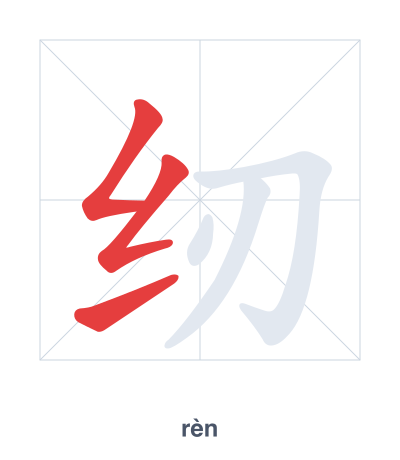
Open Hanzi Writer to see the animated stroke order and practice writing 纫 with real-time feedback.
The character 纫 (rèn) is written with 6 strokes. Follow the standard Chinese stroke order: top to bottom, left to right, outside before inside. The radical 纟 is one of its key components.
Practice the correct stroke order with the Hanzi Writer app to see animated stroke-by-stroke guidance with real-time feedback.
纫 means To thread (a needle).
纫 is a phono-semantic compound: the radical 纟 (silk, thread) indicates the action involves thread, while 刃 (rèn, knife blade) provides the pronunciation. Together they evoke the fine, precise motion of guiding thread through a needle's eye.
💡 Memory Tip: Imagine the silk thread (纟) being pushed through the sharp, blade-like eye (刃) of a needle to sew.
他在学校学习缝纫。
tā zài xué xiào xué xí féng rèn
He is learning sewing at school.
这台缝纫机很旧了。
zhè tái féng rèn jī hěn jiù le
This sewing machine is very old.
请帮我纫一下针。
qǐng bāng wǒ rèn yī xià zhēn
Please help me thread the needle.
Open Hanzi Writer to see the animated stroke order and practice writing 纫 with real-time feedback.
✨ Animated stroke order · Handwriting recognition · HSK-graded practice · Free to use
The left side is the radical 纟 (silk thread), and the right side is 刃 (rèn, blade/edge). Together, they suggest using a sharp thread or needle to pass through fabric, which connects to the meaning of threading a needle.