绫 (líng) means "Damask; thin silk" in Chinese. It has 11 strokes with the radical 纟.
Rated 4.2/5 in difficulty (advanced).
Appears in 3+ common words including 绫罗 (líng luó), 绫子 (líng zi), 绫绢 (líng juàn).
Due to its 11 strokes, Hanzi Writer's error detection shows 绫 requires focused practice — most learners need 10+ attempts for consistent accuracy.
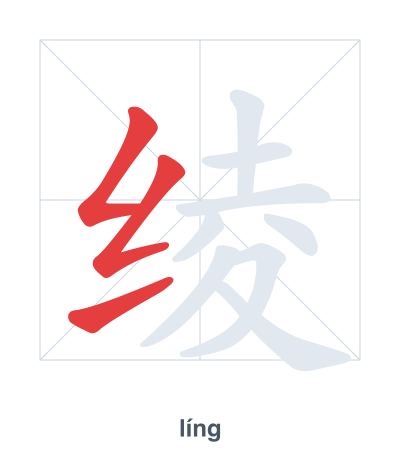
Open Hanzi Writer to see the animated stroke order and practice writing 绫 with real-time feedback.
The character 绫 (líng) is written with 11 strokes. Follow the standard Chinese stroke order: top to bottom, left to right, outside before inside. The radical 纟 is one of its key components.
Practice the correct stroke order with the Hanzi Writer app to see animated stroke-by-stroke guidance with real-time feedback.
绫 means Damask; thin silk.
绫 is a compound character with the silk radical 纟 on the left, indicating it relates to silk fabric. The right side 夌 (líng) provides the phonetic hint for pronunciation. Together, they form a word for a type of thin, patterned silk called damask.
💡 Memory Tip: Imagine a luxurious silk scarf (纟) draped over a mountain peak (夌, resembling a peak), representing the fine 'damask' textile.
绫罗绸缎很贵。
líng luó chóu duàn hěn guì
Fine silks and satins are very expensive.
这是一块红绫子。
zhè shì yī kuài hóng líng zi
This is a piece of red damask.
这种绫绢很轻。
zhè zhǒng líng juàn hěn qīng
This damask silk is very light.
Open Hanzi Writer to see the animated stroke order and practice writing 绫 with real-time feedback.
✨ Animated stroke order · Handwriting recognition · HSK-graded practice · Free to use
The left side is the radical 纟 (silk), which shows that the character is related to silk or textiles. The right side 夌 (líng) gives the sound and also hints at patterns or layering, linking to the meaning of a fine, patterned silk fabric called damask.