娥 (é) means "beautiful; good (often used in names)" in Chinese. It has 10 strokes with the radical 女, and is HSK Level 7.
Rated 4.2/5 in difficulty (advanced).
Harder than 51% of HSK Level 7 characters.
Appears in 3+ common words including 嫦娥 (cháng é), 娥眉 (é méi), 宫娥 (gōng é).
Due to its 10 strokes, Hanzi Writer's error detection shows 娥 requires focused practice — most learners need 10+ attempts for consistent accuracy.
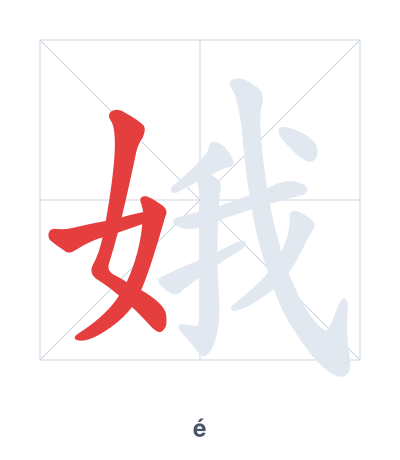
Open Hanzi Writer to see the animated stroke order and practice writing 娥 with real-time feedback.
The character 娥 (é) is written with 10 strokes. Follow the standard Chinese stroke order: top to bottom, left to right, outside before inside. The radical 女 is one of its key components.
Practice the correct stroke order with the Hanzi Writer app to see animated stroke-by-stroke guidance with real-time feedback.
娥 means beautiful; good (often used in names).
As an HSK Level 7 character, 娥 is an intermediate-level character.
娥 is a compound character combining the radical 女 (woman) with the phonetic component 我 (wǒ, 'I' or 'self'), which here provides pronunciation but also suggests personal beauty. The character originally meant a woman who is graceful and beautiful, often used in names like Chang'e (嫦娥), the moon goddess.
💡 Memory Tip: Picture a woman (女) saying 'I (我) am beautiful!' as she poses elegantly.
嫦娥住在月亮上。
cháng é zhù zài yuè liàng shàng
Chang'e lives on the moon.
她的娥眉很漂亮。
tā de é méi hěn piào liàng
Her delicate eyebrows are very beautiful.
宫娥在院子里跳舞。
gōng é zài yuàn zi lǐ tiào wǔ
The palace maids are dancing in the courtyard.
Open Hanzi Writer to see the animated stroke order and practice writing 娥 with real-time feedback.
✨ Animated stroke order · Handwriting recognition · HSK-graded practice · Free to use
娥 is made of the radical 女 (woman) on the left and 我 (wǒ, meaning 'I' or 'self') on the right. The 女 radical connects to beauty and femininity, while 我 provides the pronunciation é. Together they suggest a beautiful woman.