妲 (dá) means "Da (used in names)" in Chinese. It has 8 strokes with the radical 女.
Rated 3.7/5 in difficulty (challenging).
Appears in 3+ common words including 妲己 (dá jǐ), 苏妲己 (sū dá jǐ), 妲妲 (dá dá).
Due to its 8 strokes, Hanzi Writer's error detection shows 妲 requires focused practice — most learners need 10+ attempts for consistent accuracy.
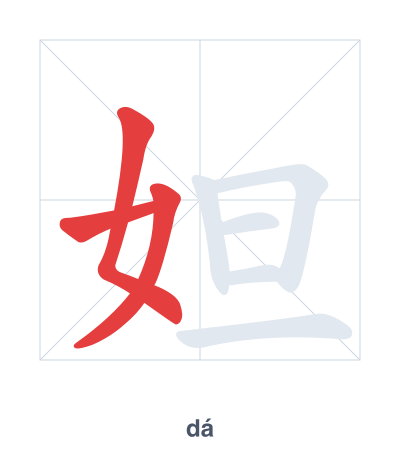
Open Hanzi Writer to see the animated stroke order and practice writing 妲 with real-time feedback.
The character 妲 (dá) is written with 8 strokes. Follow the standard Chinese stroke order: top to bottom, left to right, outside before inside. The radical 女 is one of its key components.
Practice the correct stroke order with the Hanzi Writer app to see animated stroke-by-stroke guidance with real-time feedback.
妲 means Da (used in names).
This character combines the radical 女 (woman) with 旦 (dàn, 'dawn') as a phonetic component. It is primarily used in proper names, most famously for Daji, the legendary consort of King Zhou of Shang.
💡 Memory Tip: Picture a woman (女) at dawn (旦) named Dá, standing by a window as the sun rises.
妲己是古代传说的人物。
dá jǐ shì gǔ dài chuán shuō de rén wù
Daji is a figure from ancient legends.
故事里提到了苏妲己。
gù shì lǐ tí dào le sū dá jǐ
Su Daji was mentioned in the story.
这个字读作dá。
zhè ge zì dú zuò dá。
This character is pronounced 'dá'.
Open Hanzi Writer to see the animated stroke order and practice writing 妲 with real-time feedback.
✨ Animated stroke order · Handwriting recognition · HSK-graded practice · Free to use
妲 is composed of the radical 女 (woman) on the left and 旦 (dàn, meaning dawn) on the right. The radical 女 indicates the character is related to a female name, while 旦 adds phonetic value, as 妲 is pronounced dá. The meaning "used in names" comes entirely from its use in the historical figure 妲己.