宫 (gōng) means "Palace" in Chinese. It has 9 strokes with the radical 宀, and is HSK Level 6.
Rated 4/5 in difficulty (challenging).
Harder than 45% of HSK Level 6 characters.
Appears in 3+ common words including 故宫 (gù gōng), 迷宫 (mí gōng), 皇宫 (huáng gōng).
Due to its 9 strokes, Hanzi Writer's error detection shows 宫 requires focused practice — most learners need 10+ attempts for consistent accuracy.
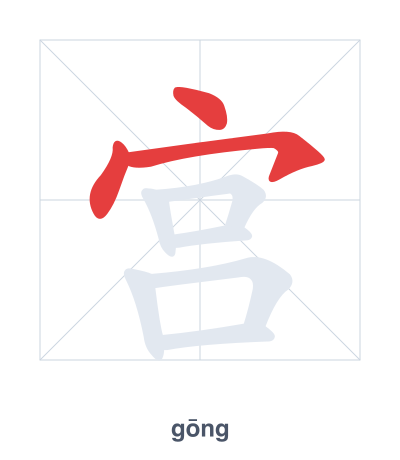
Open Hanzi Writer to see the animated stroke order and practice writing 宫 with real-time feedback.
The character 宫 (gōng) is written with 9 strokes. Follow the standard Chinese stroke order: top to bottom, left to right, outside before inside. The radical 宀 is one of its key components.
Practice the correct stroke order with the Hanzi Writer app to see animated stroke-by-stroke guidance with real-time feedback.
宫 means Palace.
As an HSK Level 6 character, 宫 is an intermediate-level character.
The character 宫 combines the radical 宀 (roof) with 吕 (two mouths stacked), representing connected rooms or halls under one roof. Ancient forms depicted a large building complex with multiple chambers, emphasizing the palace as a grand, multi-roomed structure.
💡 Memory Tip: Imagine a royal palace with a sweeping roof (宀) covering two grand halls (the two 口 stacked as 吕), each echoing with courtly chatter.
故宫在北京。
gù gōng zài běi jīng
The Forbidden City is in Beijing.
我走出了迷宫。
wǒ zǒu chū le mí gōng
I walked out of the maze.
皇宫非常大。
huáng gōng fēi cháng dà
The imperial palace is very large.
Open Hanzi Writer to see the animated stroke order and practice writing 宫 with real-time feedback.
✨ Animated stroke order · Handwriting recognition · HSK-graded practice · Free to use
The character 宫 consists of the radical 宀 (roof) on top and 吕 (two mouths or rooms) below. Together, the roof covering two rooms represents a palace or a large building with multiple chambers.