惰 (duò) means "lazy" in Chinese. It has 12 strokes with the radical 忄, and is HSK Level 7.
Rated 4.2/5 in difficulty (advanced).
Harder than 56% of HSK Level 7 characters.
Appears in 3+ common words including 懒惰 (lǎn duò), 惰性 (duò xìng), 怠惰 (dài duò).
Due to its 12 strokes, Hanzi Writer's error detection shows 惰 requires focused practice — most learners need 10+ attempts for consistent accuracy.
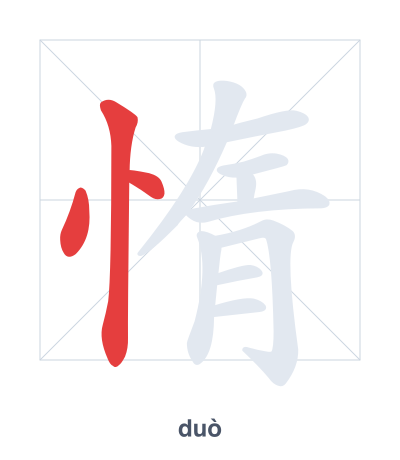
Open Hanzi Writer to see the animated stroke order and practice writing 惰 with real-time feedback.
The character 惰 (duò) is written with 12 strokes. Follow the standard Chinese stroke order: top to bottom, left to right, outside before inside. The radical 忄 is one of its key components.
Practice the correct stroke order with the Hanzi Writer app to see animated stroke-by-stroke guidance with real-time feedback.
惰 means lazy.
As an HSK Level 7 character, 惰 is an intermediate-level character.
The character 惰 combines the heart radical 忄 (xīn, indicating emotion or state of mind) with 隋 (duò, which originally meant 'to fall' or 'crumbling'). Together, they suggest a heart that has collapsed into a state of idleness—a mind that has fallen into laziness.
💡 Memory Tip: Picture a heart (忄) that has fallen (隋) off a cliff and is too lazy to climb back up.
他一点也不懒惰。
tā yì diǎn yě bù lǎn duò
He is not lazy at all.
克服学习的惰性。
kè fú xué xí de duò xìng
Overcome laziness in learning.
别再怠惰下去了。
bié zài dài duò xià qù le
Stop being lazy.
Open Hanzi Writer to see the animated stroke order and practice writing 惰 with real-time feedback.
✨ Animated stroke order · Handwriting recognition · HSK-graded practice · Free to use
The character 惰 is composed of the radical 忄 (heart/mind) on the left and the component 隋 on the right. The radical 忄 suggests that laziness is related to one's mental state or attitude. The right side 隋 provides the pronunciation (duò) and does not directly contribute to the meaning, but the combination indicates a mind that is reluctant to act.