咄 (duō) means "to scold; oh! (exclamation)" in Chinese. It has 8 strokes with the radical 口.
Rated 3.7/5 in difficulty (challenging).
Appears in 3+ common words including 咄咄逼人 (duō duō bī rén), 咄嗟 (duō jiē), 呵咄 (hē duō).
Due to its 8 strokes, Hanzi Writer's error detection shows 咄 requires focused practice — most learners need 10+ attempts for consistent accuracy.
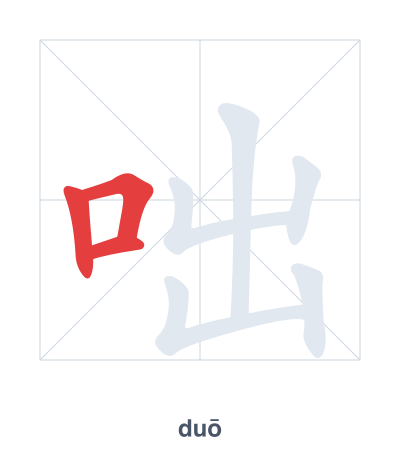
Open Hanzi Writer to see the animated stroke order and practice writing 咄 with real-time feedback.
The character 咄 (duō) is written with 8 strokes. Follow the standard Chinese stroke order: top to bottom, left to right, outside before inside. The radical 口 is one of its key components.
Practice the correct stroke order with the Hanzi Writer app to see animated stroke-by-stroke guidance with real-time feedback.
咄 means to scold; oh! (exclamation).
咄 is a phono-semantic compound: the mouth radical (口) indicates the action of speaking, while 出 (chū, 'to go out') provides the pronunciation and suggests the sound of a sharp scolding or exclamation, as if telling someone to 'get out!'
💡 Memory Tip: Picture a mouth (口) angrily shouting '出!' (go out!) — that's a scolding 'duō!'
他的态度咄咄逼人。
tā de tài dù duō duō bī rén
His attitude is aggressive and overbearing.
他在咄嗟之间完成了任务。
tā zài duō jiē zhī jiān wán chéng le rèn wù
He finished the task in an instant.
他受到了老师的呵咄。
tā shòu dào le lǎo shī de hē duō
He was scolded by the teacher.
Open Hanzi Writer to see the animated stroke order and practice writing 咄 with real-time feedback.
✨ Animated stroke order · Handwriting recognition · HSK-graded practice · Free to use
咄 combines the radical 口 (mouth) on the left and 出 (chū, to go out) on the right. The mouth radical suggests actions like speaking or making sounds, and 出 adds the idea of words "coming out" forcefully. Together they form the meaning "to scold" or an exclamation like "oh!".