督 (dū) means "To supervise." in Chinese. It has 13 strokes with the radical 目, and is HSK Level 6.
Rated 4.2/5 in difficulty (advanced).
Harder than 80% of HSK Level 6 characters.
Appears in 3+ common words including 监督 (jiān dū), 督促 (dū cù), 总督 (zǒng dū).
Due to its 13 strokes, Hanzi Writer's error detection shows 督 requires focused practice — most learners need 10+ attempts for consistent accuracy.
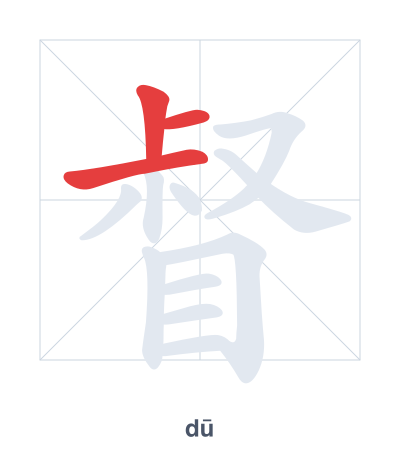
Open Hanzi Writer to see the animated stroke order and practice writing 督 with real-time feedback.
The character 督 (dū) is written with 13 strokes. Follow the standard Chinese stroke order: top to bottom, left to right, outside before inside. The radical 目 is one of its key components.
Practice the correct stroke order with the Hanzi Writer app to see animated stroke-by-stroke guidance with real-time feedback.
督 means To supervise..
As an HSK Level 6 character, 督 is an intermediate-level character.
督 is a phono-semantic compound: the radical 目 (eye) represents watching or overseeing, and 叔 (shū) provides the pronunciation. Together, the character conveys the idea of using one's eye to inspect or supervise, as in a supervisor keeping a close watch.
💡 Memory Tip: Imagine a supervisor's big eye (目) fixed on Uncle (叔) to make sure he doesn't slack off.
父母监督我学习。
fù mǔ jiān dū wǒ xué xí
My parents supervise my studies.
老师督促我们。
lǎo shī dū cù wǒ men
The teacher urges us.
他是这里的总督。
tā shì zhè lǐ de zǒng dū
He is the governor-general here.
Open Hanzi Writer to see the animated stroke order and practice writing 督 with real-time feedback.
✨ Animated stroke order · Handwriting recognition · HSK-graded practice · Free to use
督 is composed of the top part 叔 (shū, meaning uncle) and the bottom part 目 (mù, meaning eye). The eye radical suggests watching, and the character as a whole means to supervise or oversee. The 叔 part may hint at the sound, but the eye is the key semantic clue.