Hanzi Writer

How to Write 啶 (dìng) — Meaning “-dine (chemical suffix)”

dìng 11 strokes Radical: 口

啶 (dìng) means "-dine (chemical suffix)" in Chinese. It has 11 strokes with the radical 口.

Rated 4.2/5 in difficulty (advanced).

Appears in 3+ common words including 吡啶 (bǐ dìng), 嘧啶 (mì dìng), 啶烷 (dìng wán).

Due to its 11 strokes, Hanzi Writer's error detection shows 啶 requires focused practice — most learners need 10+ attempts for consistent accuracy.
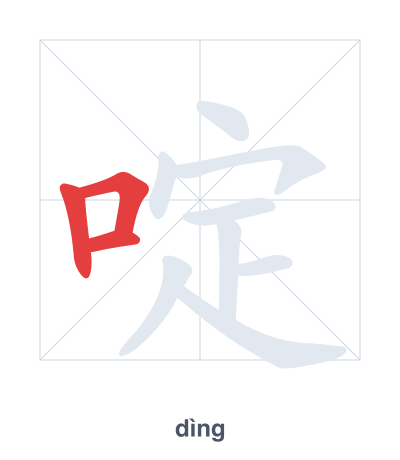
Stroke order practice for 啶 - dìng

Practice Writing 啶 (dìng)

Open Hanzi Writer to see the animated stroke order and practice writing 啶 with real-time feedback.

The character (dìng) is written with 11 strokes. Follow the standard Chinese stroke order: top to bottom, left to right, outside before inside. The radical is one of its key components.

Practice the correct stroke order with the Hanzi Writer app to see animated stroke-by-stroke guidance with real-time feedback.

means -dine (chemical suffix).

Character
Pinyindìng (ding)
Meaning-dine (chemical suffix)
Strokes11
Radical
Difficulty4.2/5

啶 is a phono-semantic compound where the radical 口 (mouth) serves as a semantic hint related to speech or sound, while 定 (dìng, meaning 'fixed' or 'settled') provides the phonetic component. This character was created to phonetically transcribe the chemical suffix '-dine' in Chinese, as in 吡啶 (bǐdìng, pyridine).

💡 Memory Tip: Imagine a chemist with a fixed (定) expression, mouth (口) wide open, yelling 'DINE!' as the name of a new chemical compound.

bǐ dìng
pyridine
mì dìng
pyrimidine
dìng wán
dinane (chemical compound)

吡啶有气味。

bǐ dìng yǒu qì wèi

Pyridine has an odor.

嘧啶很重要。

mì dìng hěn zhòng yào

Pyrimidine is very important.

啶烷是化学品。

dìng wán shì huà xué pǐn

Dinane is a chemical.

Character Pinyin Strokes Radical
(current) dìng 11
cī / zī 9
9
è 9
Stroke order practice for 啶 - dìng

Practice Writing 啶 (dìng)

Open Hanzi Writer to see the animated stroke order and practice writing 啶 with real-time feedback.

✨ Animated stroke order · Handwriting recognition · HSK-graded practice · Free to use

Frequently Asked Questions about 啶

啶 is made of the mouth radical 口 on the left and the character 定 (dìng, meaning 'fixed') on the right. The 口 radical is commonly used in Chinese characters for chemical transliterations, while 定 provides the pronunciation 'dìng'. Together they form a chemical suffix found in terms like pyridine (吡啶).

Characters with Radical 口

Other 11-Stroke Characters