嘧 (mì) means "mi (used in pyrimidine)" in Chinese. It has 14 strokes with the radical 口.
Rated 4.2/5 in difficulty (advanced).
Appears in 3+ common words including 嘧啶 (mì dìng), 胞嘧啶 (bāo mì dìng), 尿嘧啶 (niào mì dìng).
Due to its 14 strokes, Hanzi Writer's error detection shows 嘧 requires focused practice — most learners need 10+ attempts for consistent accuracy.
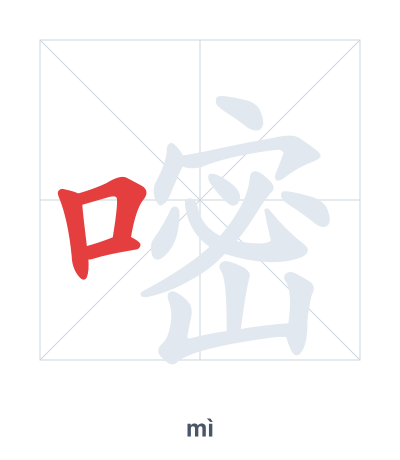
Open Hanzi Writer to see the animated stroke order and practice writing 嘧 with real-time feedback.
The character 嘧 (mì) is written with 14 strokes. Follow the standard Chinese stroke order: top to bottom, left to right, outside before inside. The radical 口 is one of its key components.
Practice the correct stroke order with the Hanzi Writer app to see animated stroke-by-stroke guidance with real-time feedback.
嘧 means mi (used in pyrimidine).
嘧 is a compound character combining the mouth radical 口 and the phonetic component 密 (mì, meaning dense or secret). The 口 likely represents the ring structure of the pyrimidine molecule, while 密 supplies the sound and hints at the tightly packed atomic arrangement.
💡 Memory Tip: Picture a dense (密) ring (口) of atoms shouting 'mi!'—that's pyrimidine.
嘧啶是一种化合物。
mì dìng shì yī zhǒng huà hé wù
Pyrimidine is a type of chemical compound.
胞嘧啶在DNA中。
bāo mì dìng zài DNA zhōng 。
Cytosine is in DNA.
尿嘧啶在RNA中。
niào mì dìng zài RNA zhōng 。
Uracil is found in RNA.
Open Hanzi Writer to see the animated stroke order and practice writing 嘧 with real-time feedback.
✨ Animated stroke order · Handwriting recognition · HSK-graded practice · Free to use
嘧 is made of the radical 口 (mouth) on the left and the phonetic component 密 (mì, meaning "dense") on the right. The 口 radical is often used in Chinese characters for chemical compounds, while 密 indicates the pronunciation. Together they form a character used exclusively in scientific terms like pyrimidine.