吡 (bǐ) means "pyridine (used in chemical names)" in Chinese. It has 7 strokes with the radical 口.
Rated 3.5/5 in difficulty (challenging).
Appears in 3+ common words including 吡啶 (bǐ dìng), 吡咯 (bǐ gē), 吡嗪 (bǐ qín).
Due to its 7 strokes, Hanzi Writer's error detection shows 吡 requires focused practice — most learners need 10+ attempts for consistent accuracy.
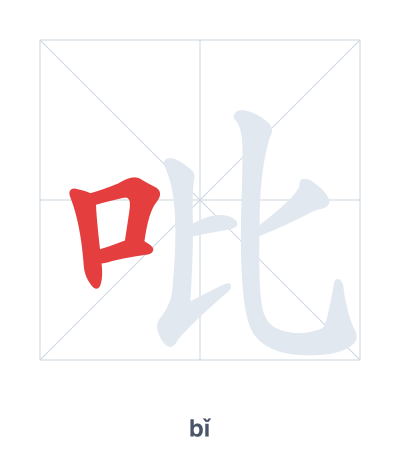
Open Hanzi Writer to see the animated stroke order and practice writing 吡 with real-time feedback.
The character 吡 (bǐ) is written with 7 strokes. Follow the standard Chinese stroke order: top to bottom, left to right, outside before inside. The radical 口 is one of its key components.
Practice the correct stroke order with the Hanzi Writer app to see animated stroke-by-stroke guidance with real-time feedback.
吡 means pyridine (used in chemical names).
This character combines the mouth radical 口 (indicating speech or sound) with the phonetic component 比 (bǐ, 'compare'). Originally it may have referred to a sound or exclamation, but in modern chemistry it is used phonetically to represent 'bi' in pyridine (吡啶).
💡 Memory Tip: Picture a mouth (口) saying 'Bee!' (比 like 'bee') while smelling a pungent pyridine chemical.
这是一个吡啶分子。
zhè shì yí gè bǐ dìng fèn zǐ
This is a pyridine molecule.
吡咯是一种有机物。
bǐ gē shì yī zhǒng yǒu jī wù
Pyrrole is an organic substance.
吡嗪常用于香料。
bǐ qín cháng yòng yú xiāng liào
Pyrazine is often used in fragrances.
Open Hanzi Writer to see the animated stroke order and practice writing 吡 with real-time feedback.
✨ Animated stroke order · Handwriting recognition · HSK-graded practice · Free to use
吡 is formed by the radical 口 (mouth) on the left and the phonetic component 比 (bǐ) on the right. The radical hints at a connection to mouth or sound, but in this character the meaning comes from its use in chemical transliterations, where 比 gives the pronunciation bǐ.