烷 (wán) means "Alkane" in Chinese. It has 11 strokes with the radical 火.
Rated 4.2/5 in difficulty (advanced).
Appears in 3+ common words including 甲烷 (jiǎ wán), 丙烷 (bǐng wán), 烷烃 (wán tīng).
Due to its 11 strokes, Hanzi Writer's error detection shows 烷 requires focused practice — most learners need 10+ attempts for consistent accuracy.
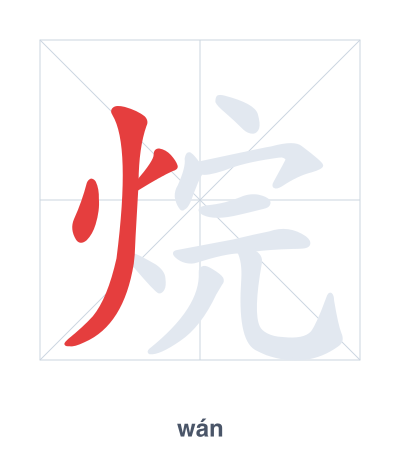
Open Hanzi Writer to see the animated stroke order and practice writing 烷 with real-time feedback.
The character 烷 (wán) is written with 11 strokes. Follow the standard Chinese stroke order: top to bottom, left to right, outside before inside. The radical 火 is one of its key components.
Practice the correct stroke order with the Hanzi Writer app to see animated stroke-by-stroke guidance with real-time feedback.
烷 means Alkane.
烷 is a compound character with the fire radical (火) indicating its connection to fuels and combustion, combined with the phonetic component 完 (wán, meaning 'complete' or 'finish'), which also hints at the saturated nature of alkanes where all carbon bonds are fully filled with hydrogen atoms.
💡 Memory Tip: Imagine a fire (火) that burns completely (完) without leaving residue, just like an alkane fuel that undergoes total combustion.
甲烷是一种无色的气体。
jiǎ wán shì yī zhǒng wú sè de qì tǐ
Methane is a colorless gas.
丙烷常用于野外做饭。
bǐng wán cháng yòng yú yě wài zuò fàn
Propane is often used for outdoor cooking.
我们在化学课学习烷烃。
wǒ men zài huà xué kè xué xí wán tīng
We are learning about alkanes in chemistry class.
Open Hanzi Writer to see the animated stroke order and practice writing 烷 with real-time feedback.
✨ Animated stroke order · Handwriting recognition · HSK-graded practice · Free to use
The left side is the radical 火 (fire), which indicates that alkanes are related to fuel and burning. The right side is 完 (wán), which gives the pronunciation and means 'complete' or 'full', suggesting a saturated hydrocarbon with full bonds.