抵 (dǐ) means "to resist or support" in Chinese. It has 8 strokes with the radical 扌, and is HSK Level 6.
Rated 3.7/5 in difficulty (challenging).
Harder than 27% of HSK Level 6 characters.
Appears in 3+ common words including 抵达 (dǐ dá), 抵抗 (dǐ kàng), 抵押 (dǐ yā).
Due to its 8 strokes, Hanzi Writer's error detection shows 抵 requires focused practice — most learners need 10+ attempts for consistent accuracy.
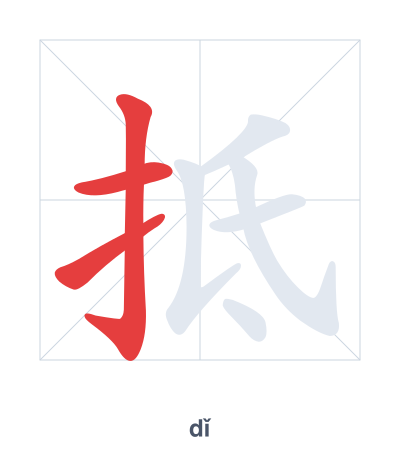
Open Hanzi Writer to see the animated stroke order and practice writing 抵 with real-time feedback.
The character 抵 (dǐ) is written with 8 strokes. Follow the standard Chinese stroke order: top to bottom, left to right, outside before inside. The radical 扌 is one of its key components.
Practice the correct stroke order with the Hanzi Writer app to see animated stroke-by-stroke guidance with real-time feedback.
抵 means to resist or support.
As an HSK Level 6 character, 抵 is an intermediate-level character.
抵 combines the hand radical 扌 with 氐 (dǐ, meaning 'base' or 'bottom'). The hand indicates an action, and 氐 suggests pressing against a foundation, together conveying the idea of pushing against something to resist or support.
💡 Memory Tip: Imagine your hand (扌) shoving against a falling stone (氐 looks like a stone with a base) to support it and keep it from crushing you.
飞机准时抵达北京。
fēi jī zhǔn shí dǐ dá běi jīng
The plane arrived in Beijing on time.
身体可以抵抗病毒。
shēn tǐ kě yǐ dǐ kàng bìng dú
The body can resist viruses.
他用房子做抵押。
tā yòng fáng zi zuò dǐ yā
He used his house as collateral.
Open Hanzi Writer to see the animated stroke order and practice writing 抵 with real-time feedback.
✨ Animated stroke order · Handwriting recognition · HSK-graded practice · Free to use
抵 is composed of the radical 扌 (hand) on the left, and the phonetic component 氐 on the right. The hand radical suggests actions involving the hand, and 氐 carries the sound while also implying a base or foundation, so together the character conveys using the hand to push against a base — either to resist or support.