抗 (kàng) means "to resist; to fight against" in Chinese. It has 7 strokes with the radical 扌, and is HSK Level 6.
Rated 3.5/5 in difficulty (challenging).
Harder than 19% of HSK Level 6 characters.
Appears in 3+ common words including 抗议 (kàng yì), 抵抗 (dǐ kàng), 对抗 (duì kàng).
Due to its 7 strokes, Hanzi Writer's error detection shows 抗 requires focused practice — most learners need 10+ attempts for consistent accuracy.
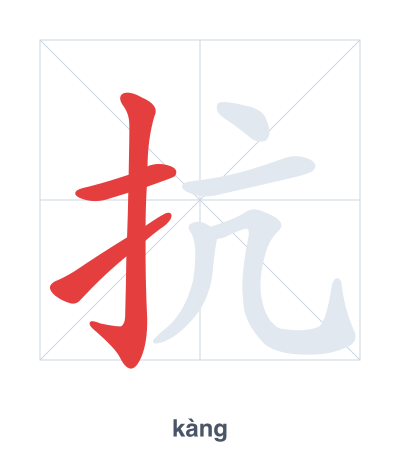
Open Hanzi Writer to see the animated stroke order and practice writing 抗 with real-time feedback.
The character 抗 (kàng) is written with 7 strokes. Follow the standard Chinese stroke order: top to bottom, left to right, outside before inside. The radical 扌 is one of its key components.
Practice the correct stroke order with the Hanzi Writer app to see animated stroke-by-stroke guidance with real-time feedback.
抗 means to resist; to fight against.
As an HSK Level 6 character, 抗 is an intermediate-level character.
抗 combines the hand radical 扌 with 亢, which originally showed a person with legs spread to suggest lifting or resisting. Together, they convey using one's hands to push against or fight back against an opposing force.
💡 Memory Tip: Picture your hand (扌) shoving back a tall, haughty figure (亢) to resist their advance.
学生们在抗议。
xué shēng men zài kàng yì
The students are protesting.
身体可以抵抗病毒。
shēn tǐ kě yǐ dǐ kàng bìng dú
The body can resist viruses.
两支球队正在对抗。
liǎng zhī qiú duì zhèng zài duì kàng
The two teams are competing against each other.
Open Hanzi Writer to see the animated stroke order and practice writing 抗 with real-time feedback.
✨ Animated stroke order · Handwriting recognition · HSK-graded practice · Free to use
抗 combines the radical 扌 (hand) on the left with 亢 on the right. The hand radical shows that resisting involves physical action, while 亢 originally meant "stiff" or "stubborn," reinforcing the idea of pushing back. Together, these parts create the meaning of using one's hand to oppose or fight against something.