坏 (huài) means "Bad; broken; spoiled." in Chinese. It has 7 strokes with the radical 土, and is HSK Level 1.
Rated 2.9/5 in difficulty (moderate).
Harder than 53% of HSK Level 1 characters.
Appears in 3+ common words including 坏人 (huài rén), 坏了 (huài le), 坏习惯 (huài xí guàn).
Hanzi Writer's stroke validation shows learners typically need 5-8 attempts to write 坏 with correct proportion and order.
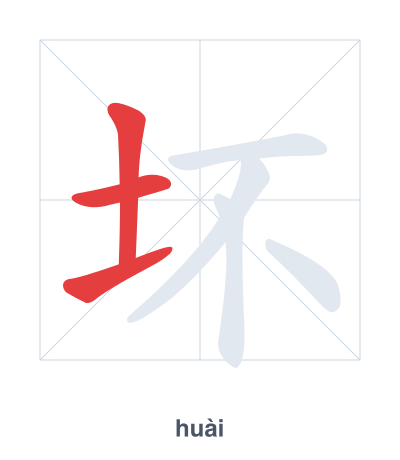
Open Hanzi Writer to see the animated stroke order and practice writing 坏 with real-time feedback.
The character 坏 (huài) is written with 7 strokes. Follow the standard Chinese stroke order: top to bottom, left to right, outside before inside. The radical 土 is one of its key components.
Practice the correct stroke order with the Hanzi Writer app to see animated stroke-by-stroke guidance with real-time feedback.
坏 means Bad; broken; spoiled..
As an HSK Level 1 character, 坏 is among the first characters beginners learn.
坏 combines the radical 土 (earth) with the phonetic component 不 (not), suggesting something that is not stable or solid like earth—hence broken or spoiled. Historically, it simplified from 壞, which depicted a wall crumbling (土) with a sound component, but today's structure directly implies 'not (不) good earth (土).'
💡 Memory Tip: Imagine a pile of dirt (土) with a big red 'X' (不) on it, meaning it's spoiled and bad.
他不是一个坏人。
tā bú shì yí gè huài rén
He is not a bad person.
我的手机坏了。
wǒ de shǒu jī huài le
My phone is broken.
我们要改掉坏习惯。
wǒ men yào gǎi diào huài xí guàn
We need to break bad habits.
Open Hanzi Writer to see the animated stroke order and practice writing 坏 with real-time feedback.
✨ Animated stroke order · Handwriting recognition · HSK-graded practice · Free to use
坏 is made of the radical 土 (earth) on the left and the character 不 (not) on the right. Together they suggest something that is 'not solid' or 'not good,' like broken earth, which leads to the meanings 'bad,' 'broken,' or 'spoiled.'