粟 (sù) means "millet" in Chinese. It has 12 strokes with the radical 米.
Rated 4.2/5 in difficulty (advanced).
Appears in 3+ common words including 粟米 (sù mǐ), 沧海一粟 (cāng hǎi yī sù), 罂粟 (yīng sù).
Due to its 12 strokes, Hanzi Writer's error detection shows 粟 requires focused practice — most learners need 10+ attempts for consistent accuracy.
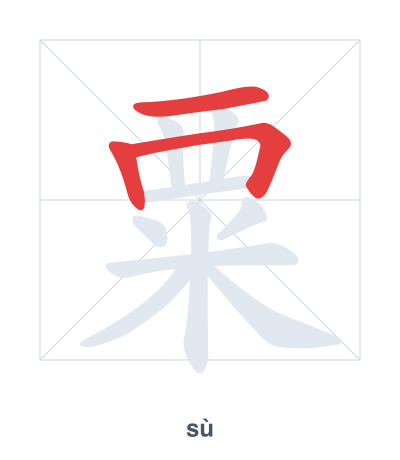
Open Hanzi Writer to see the animated stroke order and practice writing 粟 with real-time feedback.
The character 粟 (sù) is written with 12 strokes. Follow the standard Chinese stroke order: top to bottom, left to right, outside before inside. The radical 米 is one of its key components.
Practice the correct stroke order with the Hanzi Writer app to see animated stroke-by-stroke guidance with real-time feedback.
粟 means millet.
粟 (sù) combines the radical 米 (rice/grain) with 㐭 (a granary or container). The character originally depicted millet grains stored in a container, emphasizing its role as a staple grain. Over time, the top component simplified into its current form.
💡 Memory Tip: Picture a basket (the top part) overflowing with tiny golden millet grains (米) spilling out.
粟米就是我们说的小米。
sù mǐ jiù shì wǒ men shuō de xiǎo mǐ
'Sumi' is what we call millet.
个人在世界中只是沧海一粟。
gè rén zài shì jiè zhōng zhǐ shì cāng hǎi yī sù
An individual is just a drop in the ocean in this world.
罂粟花看起来非常漂亮。
yīng sù huā kàn qǐ lái fēi cháng piào liàng
Poppies look very beautiful.
Open Hanzi Writer to see the animated stroke order and practice writing 粟 with real-time feedback.
✨ Animated stroke order · Handwriting recognition · HSK-graded practice · Free to use
粟 is composed of the radical 米 (rice/grain) on top, and the phonetic component 㐭 (sè, meaning granary or to harvest) below. The 米 directly connects the character to grain, while 㐭 hints at storage or produce, together forming the idea of "millet" as a harvested grain crop.