啐 (cuì) means "To spit; to scoff at." in Chinese. It has 11 strokes with the radical 口.
Rated 4.2/5 in difficulty (advanced).
Appears in 3+ common words including 啐了一口 (cuì le yī kǒu), 啐骂 (cuì mà), 啐唾沫 (cuì tuò mò).
Due to its 11 strokes, Hanzi Writer's error detection shows 啐 requires focused practice — most learners need 10+ attempts for consistent accuracy.
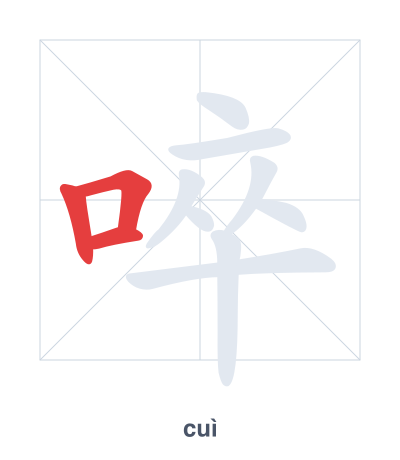
Open Hanzi Writer to see the animated stroke order and practice writing 啐 with real-time feedback.
The character 啐 (cuì) is written with 11 strokes. Follow the standard Chinese stroke order: top to bottom, left to right, outside before inside. The radical 口 is one of its key components.
Practice the correct stroke order with the Hanzi Writer app to see animated stroke-by-stroke guidance with real-time feedback.
啐 means To spit; to scoff at..
啐 combines the mouth radical (口) with 卒 (soldier or servant), which provides phonetic guidance. The image suggests a soldier (卒) using his mouth (口) to spit out something in contempt, reflecting the meaning 'to spit' or 'to scoff at.'
💡 Memory Tip: A soldier (卒) opens his mouth (口) to spit with a loud 'cuì' sound of disdain.
他向地上啐了一口。
tā xiàng dì shàng cuì le yī kǒu
He spat on the ground.
他一边走一边啐骂。
tā yī biān zǒu yī biān cuì mà
He was cursing as he walked.
别在公共场所啐唾沫。
bié zài gōng gòng chǎng suǒ cuì tuò mò
Don't spit in public places.
Open Hanzi Writer to see the animated stroke order and practice writing 啐 with real-time feedback.
✨ Animated stroke order · Handwriting recognition · HSK-graded practice · Free to use
啐 is made of the radical 口 (mouth) on the left and the phonetic component 卒 (zú, meaning soldier or sudden) on the right. The mouth radical suggests an action done with the mouth, like spitting or showing contempt. The 卒 part hints at a sudden, dismissive action, matching the meaning of scoffing.