踟 (chí) means "to hesitate" in Chinese. It has 15 strokes with the radical 足.
Rated 4.2/5 in difficulty (advanced).
Appears in 3+ common words including 踟蹰 (chí chú), 踟蹰不前 (chí chú bù qián), 略有踟蹰 (lüè yǒu chí chú).
Due to its 15 strokes, Hanzi Writer's error detection shows 踟 requires focused practice — most learners need 10+ attempts for consistent accuracy.
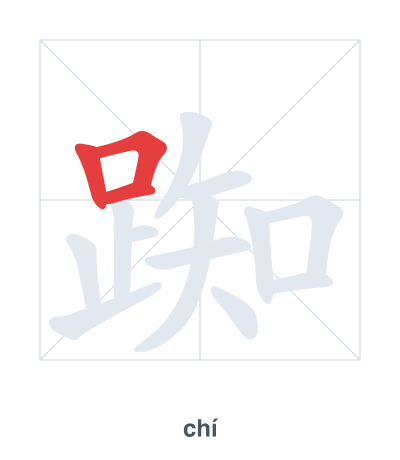
Open Hanzi Writer to see the animated stroke order and practice writing 踟 with real-time feedback.
The character 踟 (chí) is written with 15 strokes. Follow the standard Chinese stroke order: top to bottom, left to right, outside before inside. The radical 足 is one of its key components.
Practice the correct stroke order with the Hanzi Writer app to see animated stroke-by-stroke guidance with real-time feedback.
踟 means to hesitate.
踟 is a compound character with the radical 足 (foot), indicating movement, and the phonetic component 虒 (sī). The foot radical suggests walking or hesitating steps, as in pacing back and forth. This character appears in the reduplicated word 踟蹰, meaning to hesitate or waver while moving.
💡 Memory Tip: Imagine a foot (足) trapped by a strange animal (虒) that makes you stop and hesitate before stepping forward.
他在路口踟蹰。
tā zài lù kǒu chí chú
He is hesitating at the intersection.
他在困难面前踟蹰不前。
tā zài kùn nán miàn qián chí chú bù qián
He is hesitating in the face of difficulties.
他略有踟蹰。
tā lüè yǒu chí chú
He hesitated a little.
Open Hanzi Writer to see the animated stroke order and practice writing 踟 with real-time feedback.
✨ Animated stroke order · Handwriting recognition · HSK-graded practice · Free to use
踟 is composed of the radical 足 (foot) on the left and the phonetic component 彳 (a step) combined with 寺 (temple) on the right. The foot radical suggests movement, while the overall structure conveys the idea of walking hesitantly, like stopping and starting. This matches the character's meaning of "to hesitate."