蹰 (chú) means "to hesitate" in Chinese. It has 19 strokes with the radical 足.
Rated 4.2/5 in difficulty (advanced).
Appears in 3+ common words including 踟蹰 (chí chú), 踟蹰不前 (chí chú bù qián), 蹰步 (chú bù).
Due to its 19 strokes, Hanzi Writer's error detection shows 蹰 requires focused practice — most learners need 10+ attempts for consistent accuracy.
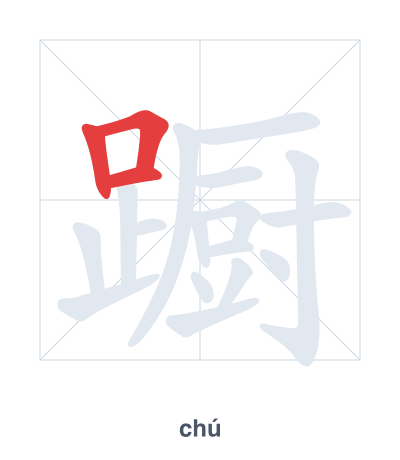
Open Hanzi Writer to see the animated stroke order and practice writing 蹰 with real-time feedback.
The character 蹰 (chú) is written with 19 strokes. Follow the standard Chinese stroke order: top to bottom, left to right, outside before inside. The radical 足 is one of its key components.
Practice the correct stroke order with the Hanzi Writer app to see animated stroke-by-stroke guidance with real-time feedback.
蹰 means to hesitate.
蹰 is a phono-semantic compound: the left side 足 (foot) suggests movement, and the right side 厨 (chú, meaning 'kitchen') provides the sound. The word is often used in the reduplicated form 踟蹰 (chí chú) to describe pacing back and forth, capturing the idea of hesitation through uncertain footsteps.
💡 Memory Tip: Imagine someone hesitating outside a kitchen (厨), nervously tapping their foot (足) back and forth before deciding to enter.
他在门口踟蹰不前。
tā zài mén kǒu chí chú bù qián
He is wavering at the door.
面对困难,不要踟蹰不前。
miàn duì kùn nán bú yào chí chú bù qián
Don't hesitate when facing difficulties.
他在小路上缓慢蹰步。
tā zài xiǎo lù shàng huǎn màn chú bù
He is pacing slowly on the path.
Open Hanzi Writer to see the animated stroke order and practice writing 蹰 with real-time feedback.
✨ Animated stroke order · Handwriting recognition · HSK-graded practice · Free to use
蹰 is composed of 足 (foot) on the left and 厨 (kitchen) on the right. The foot radical suggests movement, while the right side hints at hesitation (like pacing in a kitchen, undecided about what to do). Together they form the idea of hesitating or shuffling one's feet.