嗤 (chī) means "To sneer or laugh at." in Chinese. It has 13 strokes with the radical 口.
Rated 4.2/5 in difficulty (advanced).
Appears in 3+ common words including 嗤笑 (chī xiào), 嗤之以鼻 (chī zhī yǐ bí), 嗤嗤 (chī chī).
Due to its 13 strokes, Hanzi Writer's error detection shows 嗤 requires focused practice — most learners need 10+ attempts for consistent accuracy.
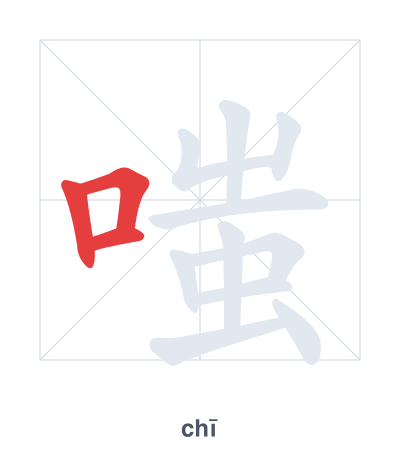
Open Hanzi Writer to see the animated stroke order and practice writing 嗤 with real-time feedback.
The character 嗤 (chī) is written with 13 strokes. Follow the standard Chinese stroke order: top to bottom, left to right, outside before inside. The radical 口 is one of its key components.
Practice the correct stroke order with the Hanzi Writer app to see animated stroke-by-stroke guidance with real-time feedback.
嗤 means To sneer or laugh at..
嗤 is a phono-semantic compound: the mouth radical (口) indicates the action of making a sound, while 蚩 (chī, a mythical demon or insect) provides the pronunciation and adds a nuance of foolishness or ugliness—together they depict sneering or laughing at someone seen as ridiculous.
💡 Memory Tip: Imagine a mouth (口) letting out a sharp 'chī' sound as it sneers at a silly bug (蚩) crawling by.
别嗤笑别人。
bié chī xiào bié rén
Don't sneer at others.
他对此嗤之以鼻。
tā duì cǐ chī zhī yǐ bí
He scoffed at this.
她嗤嗤地笑。
tā chī chī dì xiào
She giggled.
Open Hanzi Writer to see the animated stroke order and practice writing 嗤 with real-time feedback.
✨ Animated stroke order · Handwriting recognition · HSK-graded practice · Free to use
The character 嗤 is formed by the radical 口 (mouth) on the left and the phonetic component 蚩 (chī) on the right. The mouth radical indicates the action is done with the mouth, while 蚩 contributes the sound and also carries an ancient meaning of 'to mock'. Together, they create the idea of sneering or laughing at someone.