蝉 (chán) means "Cicada" in Chinese. It has 14 strokes with the radical 虫.
Rated 4.2/5 in difficulty (advanced).
Appears in 3+ common words including 蝉鸣 (chán míng), 听蝉 (tīng chán), 蝉蜕 (chán tuì).
Due to its 14 strokes, Hanzi Writer's error detection shows 蝉 requires focused practice — most learners need 10+ attempts for consistent accuracy.
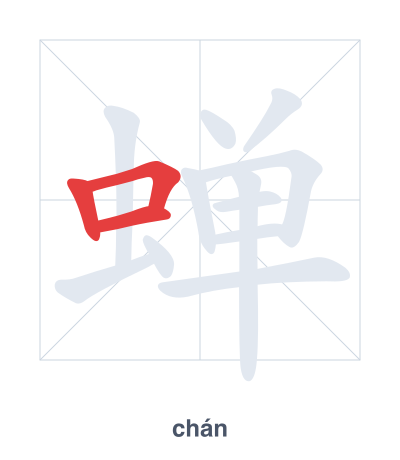
Open Hanzi Writer to see the animated stroke order and practice writing 蝉 with real-time feedback.
The character 蝉 (chán) is written with 14 strokes. Follow the standard Chinese stroke order: top to bottom, left to right, outside before inside. The radical 虫 is one of its key components.
Practice the correct stroke order with the Hanzi Writer app to see animated stroke-by-stroke guidance with real-time feedback.
蝉 means Cicada.
蝉 is a phono-semantic compound: the left radical 虫 (insect) indicates it belongs to the insect class, while the right component 单 (dān, 'single') provides the sound chán. Ancient Chinese depicted cicadas as distinct insects known for their loud, single-note calls.
💡 Memory Tip: Picture a single (单) insect (虫) that sings one long, buzzing note—the cicada.
夏天的蝉鸣很响。
xià tiān de chán míng hěn xiǎng
The cicadas' chirping is very loud in summer.
树上有蝉在叫。
shù shàng yǒu chán zài jiào
A cicada is chirping in the tree.
蝉在树上脱壳了。
chán zài shù shàng tuō ké le
The cicada shed its shell on the tree.
Open Hanzi Writer to see the animated stroke order and practice writing 蝉 with real-time feedback.
✨ Animated stroke order · Handwriting recognition · HSK-graded practice · Free to use
蝉 combines the radical 虫 (insect) on the left with 单 (dān, single) on the right. The insect radical tells you it is a type of bug, while 单 hints at the cicada's solo chirping.