蜕 (tuì) means "to molt; exuviae" in Chinese. It has 13 strokes with the radical 虫.
Rated 4.2/5 in difficulty (advanced).
Appears in 3+ common words including 蜕变 (tuì biàn), 蜕皮 (tuì pí), 蜕化 (tuì huà).
Due to its 13 strokes, Hanzi Writer's error detection shows 蜕 requires focused practice — most learners need 10+ attempts for consistent accuracy.
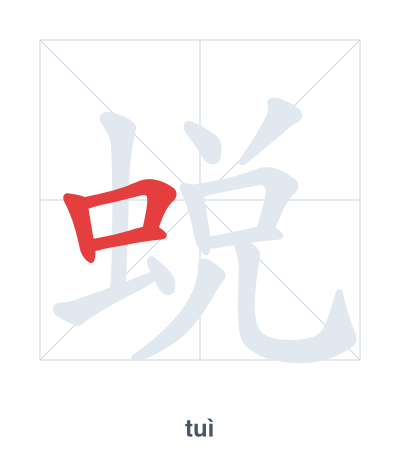
Open Hanzi Writer to see the animated stroke order and practice writing 蜕 with real-time feedback.
The character 蜕 (tuì) is written with 13 strokes. Follow the standard Chinese stroke order: top to bottom, left to right, outside before inside. The radical 虫 is one of its key components.
Practice the correct stroke order with the Hanzi Writer app to see animated stroke-by-stroke guidance with real-time feedback.
蜕 means to molt; exuviae.
蜕 is a compound character formed by the radical 虫 (insect) on the left and the phonetic component 兑 (duì, meaning 'exchange') on the right. The combination depicts an insect exchanging or shedding its old skin, which is the process of molting.
💡 Memory Tip: Picture a bug (虫) that 'exchanges' (兑) its old skin for a fresh new one.
他完成了人生的蜕变。
tā wán chéng le rén shēng de tuì biàn
He completed a transformation in his life.
蛇每年都会蜕皮。
shé měi nián dū huì tuì pí
Snakes shed their skin every year.
这种物质已经蜕化了。
zhè zhǒng wù zhì yǐ jīng tuì huà le
This substance has deteriorated.
Open Hanzi Writer to see the animated stroke order and practice writing 蜕 with real-time feedback.
✨ Animated stroke order · Handwriting recognition · HSK-graded practice · Free to use
The character 蜕 is made of the radical 虫 (insect) on the left and 兑 (duì) on the right as a phonetic component. The insect radical hints that the meaning involves insects, which often molt. The right part 兑 gives the approximate pronunciation tuì, though its own pinyin is duì.