厕 (cè) means "toilet; restroom" in Chinese. It has 8 strokes with the radical 厂, and is HSK Level 6.
Rated 3.4/5 in difficulty (challenging).
Harder than 16% of HSK Level 6 characters.
Appears in 3+ common words including 厕所 (cè suǒ), 男厕 (nán cè), 公厕 (gōng cè).
Due to its 8 strokes, Hanzi Writer's error detection shows 厕 requires focused practice — most learners need 10+ attempts for consistent accuracy.
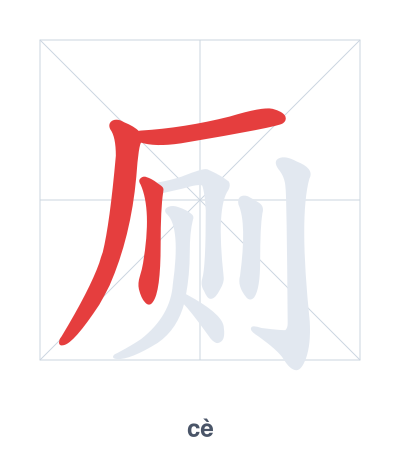
Open Hanzi Writer to see the animated stroke order and practice writing 厕 with real-time feedback.
The character 厕 (cè) is written with 8 strokes. Follow the standard Chinese stroke order: top to bottom, left to right, outside before inside. The radical 厂 is one of its key components.
Practice the correct stroke order with the Hanzi Writer app to see animated stroke-by-stroke guidance with real-time feedback.
厕 means toilet; restroom.
As an HSK Level 6 character, 厕 is an intermediate-level character.
厕 combines the radical 厂 (cliff or shelter) with 则 (cè), which contributes pronunciation. It originally referred to a small side-building or latrine, reflecting a structure set apart for waste.
💡 Memory Tip: Imagine a shelter (厂) where you follow a strict rule (则) to relieve yourself.
厕所在哪儿?
cè suǒ zài nǎ ér
Where is the restroom?
男厕在左边。
nán cè zài zuǒ biān
The men's restroom is on the left.
公园里有公厕。
gōng yuán lǐ yǒu gōng cè
There are public toilets in the park.
Open Hanzi Writer to see the animated stroke order and practice writing 厕 with real-time feedback.
✨ Animated stroke order · Handwriting recognition · HSK-graded practice · Free to use
The character 厕 combines the radical 厂 (cliff or factory, suggesting a building or shelter) and the phonetic component 则 (zé, meaning rule or pattern). Together, they form a structure that originally referred to a latrine or outhouse, often a small building with a specific layout. The radical provides the shelter idea, while 则 gives the pronunciation.