男 (nán) means "Male" in Chinese. It has 7 strokes with the radical 田, and is HSK Level 1.
Rated 2.9/5 in difficulty (moderate).
Harder than 57% of HSK Level 1 characters.
Appears in 3+ common words including 男生 (nán shēng), 男朋友 (nán péng yǒu), 男人 (nán rén).
Hanzi Writer's stroke validation shows learners typically need 5-8 attempts to write 男 with correct proportion and order.
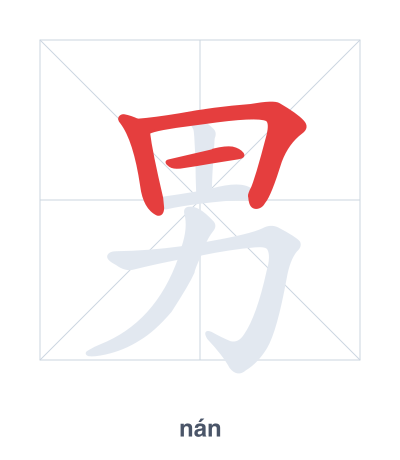
Open Hanzi Writer to see the animated stroke order and practice writing 男 with real-time feedback.
The character 男 (nán) is written with 7 strokes. Follow the standard Chinese stroke order: top to bottom, left to right, outside before inside. The radical 田 is one of its key components.
Practice the correct stroke order with the Hanzi Writer app to see animated stroke-by-stroke guidance with real-time feedback.
男 means Male.
As an HSK Level 1 character, 男 is among the first characters beginners learn.
男 is a compound of 田 (field) and 力 (strength), depicting a man using his physical power to work the land. In ancient China, men were primarily responsible for farming, so the character visually represents 'male' as one who labors in the fields.
💡 Memory Tip: Imagine a man putting all his strength (力) into plowing a square field (田) to provide for his family.
班里有一半是男生。
bān lǐ yǒu yí bàn shì nán shēng
Half of the class are boys.
那是她的男朋友。
nà shì tā de nán péng yǒu
That is her boyfriend.
他是一个负责任的男人。
tā shì yí gè fù zé rèn de nán rén
He is a responsible man.
Open Hanzi Writer to see the animated stroke order and practice writing 男 with real-time feedback.
✨ Animated stroke order · Handwriting recognition · HSK-graded practice · Free to use
男 is made of two parts: 田 (field) on top and 力 (strength) below. In ancient times, men worked in the fields using their strength, so the character combines these ideas to mean 'male'.