孺 (rú) means "Child; young." in Chinese. It has 17 strokes with the radical 子.
Rated 4.2/5 in difficulty (advanced).
Appears in 3+ common words including 孺子 (rú zi), 妇孺 (fù rú), 孺慕 (rú mù).
Due to its 17 strokes, Hanzi Writer's error detection shows 孺 requires focused practice — most learners need 10+ attempts for consistent accuracy.
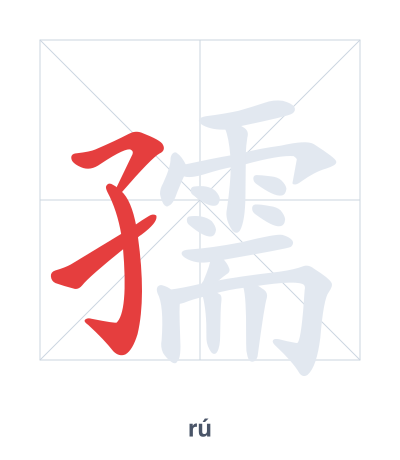
Open Hanzi Writer to see the animated stroke order and practice writing 孺 with real-time feedback.
The character 孺 (rú) is written with 17 strokes. Follow the standard Chinese stroke order: top to bottom, left to right, outside before inside. The radical 子 is one of its key components.
Practice the correct stroke order with the Hanzi Writer app to see animated stroke-by-stroke guidance with real-time feedback.
孺 means Child; young..
| Character | 孺 |
| Pinyin | rú (ru) |
| Meaning | Child; young. |
| Strokes | 17 |
| Radical | 子 |
| Difficulty | 4.2/5 |
孺 combines the radical 子 (child) with 需 (xū, 'to need' and phonetic component), indicating a young child who requires care and nourishment. The original meaning referred to an infant or toddler, emphasizing vulnerability and dependence.
💡 Memory Tip: Picture a child (子) who constantly needs (需) a hug or feeding—that's a young 孺 (rú) child.
孺子可教也。
rú zǐ kě jiào yě
This young person shows great promise.
妇孺皆知这件事。
fù rú jiē zhī zhè jiàn shì
Everyone, including women and children, knows about this.
他对母亲很孺慕。
tā duì mǔ qīn hěn rú mù
He has a deep affection for his mother.
Open Hanzi Writer to see the animated stroke order and practice writing 孺 with real-time feedback.
✨ Animated stroke order · Handwriting recognition · HSK-graded practice · Free to use
孺 is a left-right character. The left side is 子 (child), which gives the meaning of 'child' or 'young.' The right side is 需 (xū), which acts as a phonetic component and does not directly contribute to the meaning.