嘭 (pēng) means "bang; thump" in Chinese. It has 15 strokes with the radical 口.
Rated 4.2/5 in difficulty (advanced).
Appears in 3+ common words including 嘭 (pēng), 嘭嘭 (pēng pēng), 嘭地 (pēng dì).
Due to its 15 strokes, Hanzi Writer's error detection shows 嘭 requires focused practice — most learners need 10+ attempts for consistent accuracy.
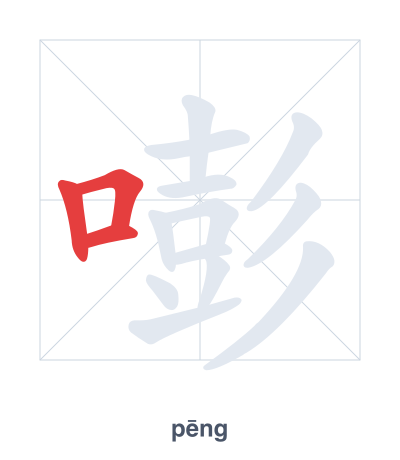
Open Hanzi Writer to see the animated stroke order and practice writing 嘭 with real-time feedback.
The character 嘭 (pēng) is written with 15 strokes. Follow the standard Chinese stroke order: top to bottom, left to right, outside before inside. The radical 口 is one of its key components.
Practice the correct stroke order with the Hanzi Writer app to see animated stroke-by-stroke guidance with real-time feedback.
嘭 means bang; thump.
嘭 is a compound character combining the mouth radical (口) to indicate sound, with the phonetic component 彭 (péng), which originally depicted a drum with decorative strokes. Together, they convey the loud, banging noise of a drum or a heavy thump.
💡 Memory Tip: Imagine a wide open mouth (口) next to a drum (彭) that explodes with a huge BANG when struck, spraying three decorative lines (彡) outward.
嘭,门关上了。
pēng mén guān shàng le
Bang! The door closed.
敲门声嘭嘭响。
qiāo mén shēng pēng pēng xiǎng
The knocking on the door was a loud thudding sound.
嘭地一声巨响。
pēng dì yī shēng jù xiǎng
There was a loud bang.
Open Hanzi Writer to see the animated stroke order and practice writing 嘭 with real-time feedback.
✨ Animated stroke order · Handwriting recognition · HSK-graded practice · Free to use
嘭 is composed of the mouth radical 口 on the left and 彭 on the right. 彭 itself relates to the sound of a drum, so 口 + 彭 together create the idea of a loud banging noise made by the mouth or a sound source.