响 (xiǎng) means "loud; sound; to ring" in Chinese. It has 9 strokes with the radical 口, and is HSK Level 2.
Rated 3.5/5 in difficulty (challenging).
Harder than 60% of HSK Level 2 characters.
Appears in 3+ common words including 响亮 (xiǎng liàng), 影响 (yǐng xiǎng), 响声 (xiǎng shēng).
Due to its 9 strokes, Hanzi Writer's error detection shows 响 requires focused practice — most learners need 10+ attempts for consistent accuracy.
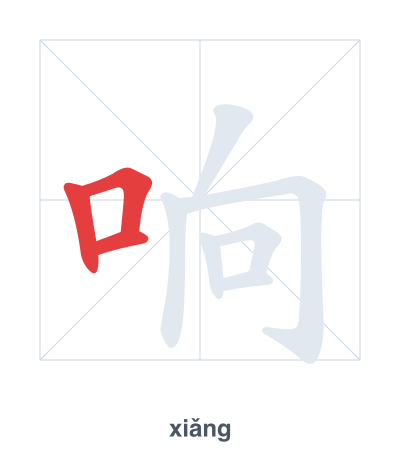
Open Hanzi Writer to see the animated stroke order and practice writing 响 with real-time feedback.
The character 响 (xiǎng) is written with 9 strokes. Follow the standard Chinese stroke order: top to bottom, left to right, outside before inside. The radical 口 is one of its key components.
Practice the correct stroke order with the Hanzi Writer app to see animated stroke-by-stroke guidance with real-time feedback.
响 means loud; sound; to ring.
As an HSK Level 2 character, 响 is among the first characters beginners learn.
响 combines the radical 口 (mouth) with 向 (direction/facing). The mouth facing outward suggests producing or directing sound, hence meanings of loud noise, sound, or ringing.
💡 Memory Tip: Imagine a mouth (口) turned toward you (向) shouting a loud sound that rings in your ears.
他的声音很响亮。
tā de shēng yīn hěn xiǎng liàng
His voice is very loud and clear.
别影响他学习。
bié yǐng xiǎng tā xué xí
Don't disturb his studies.
我听到了响声。
wǒ tīng dào le xiǎng shēng
I heard a noise.
Open Hanzi Writer to see the animated stroke order and practice writing 响 with real-time feedback.
✨ Animated stroke order · Handwriting recognition · HSK-graded practice · Free to use
响 combines the radical 口 (mouth) on the left and 向 (direction) on the right. The mouth radical suggests sound or speech, while 向 gives a phonetic hint for the pronunciation xiǎng. Together, they create the idea of a sound traveling in a direction, meaning 'loud' or 'to ring'.