咔 (kā) means "click; crack (onomatopoeia)" in Chinese. It has 8 strokes with the radical 口.
Rated 3.7/5 in difficulty (challenging).
Appears in 3+ common words including 咔嚓 (kā chā), 咔哒 (kā dá), 咔叽 (kā jī).
Due to its 8 strokes, Hanzi Writer's error detection shows 咔 requires focused practice — most learners need 10+ attempts for consistent accuracy.
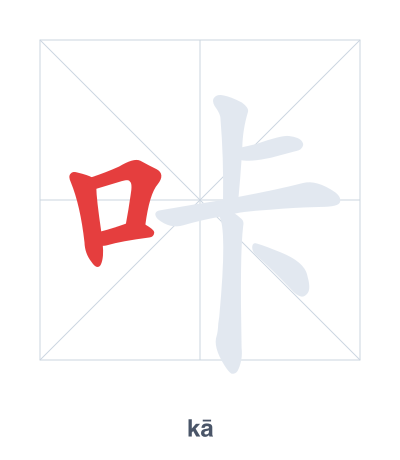
Open Hanzi Writer to see the animated stroke order and practice writing 咔 with real-time feedback.
The character 咔 (kā) is written with 8 strokes. Follow the standard Chinese stroke order: top to bottom, left to right, outside before inside. The radical 口 is one of its key components.
Practice the correct stroke order with the Hanzi Writer app to see animated stroke-by-stroke guidance with real-time feedback.
咔 means click; crack (onomatopoeia).
咔 is a compound character with the mouth radical (口) indicating it relates to sound, and the phonetic component 卡 (kǎ) providing pronunciation. Together, they represent the onomatopoeic 'click' or 'crack' sound, as if a mouth is making a sharp noise.
💡 Memory Tip: Imagine a mouth (口) saying 'ka!' as it bites down and cracks a card (卡) in half with a loud click.
树枝咔嚓一声断了。
shù zhī kā chā yī shēng duàn le
The branch snapped with a crack.
门咔哒一声关上了。
mén kā dá yī shēng guān shàng le
The door closed with a click.
他穿着咔叽布裤子。
tā chuān zhe kā jī bù kù zi
He is wearing khaki pants.
Open Hanzi Writer to see the animated stroke order and practice writing 咔 with real-time feedback.
✨ Animated stroke order · Handwriting recognition · HSK-graded practice · Free to use
咔 is formed by the mouth radical 口 on the left and the phonetic component 卡 (kǎ) on the right. The mouth radical signals that the character represents a sound, while 卡 gives the pronunciation and suggests a crisp, breaking sound. Together, they create an onomatopoeia for clicking or cracking noises.