瘪 (biě) means "shriveled or deflated" in Chinese. It has 15 strokes with the radical 疒.
Rated 4.2/5 in difficulty (advanced).
Appears in 3+ common words including 瘪了 (biě le), 干瘪 (gān biě), 瘪胎 (biě tāi).
Due to its 15 strokes, Hanzi Writer's error detection shows 瘪 requires focused practice — most learners need 10+ attempts for consistent accuracy.
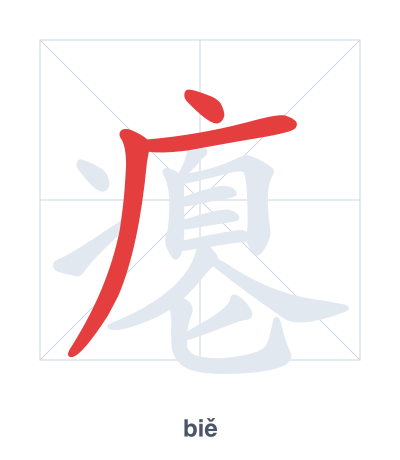
Open Hanzi Writer to see the animated stroke order and practice writing 瘪 with real-time feedback.
The character 瘪 (biě) is written with 15 strokes. Follow the standard Chinese stroke order: top to bottom, left to right, outside before inside. The radical 疒 is one of its key components.
Practice the correct stroke order with the Hanzi Writer app to see animated stroke-by-stroke guidance with real-time feedback.
瘪 means shriveled or deflated.
The character 瘪 combines the radical 疒 (indicating illness or defect) with 扁 (meaning 'flat'). Together, they depict something that has become flattened or shriveled due to sickness or loss of internal substance, like a deflated balloon or a withered fruit.
💡 Memory Tip: Imagine a sick (疒) person lying on a flat (扁) mattress, looking completely deflated and shriveled.
气球已经瘪了。
qì qiú yǐ jīng biě le
The balloon has deflated.
这个苹果干瘪了。
zhè ge píng guǒ gān biě le
This apple has shriveled up.
自行车瘪胎了。
zì xíng chē biě tāi le
The bicycle has a flat tire.
Open Hanzi Writer to see the animated stroke order and practice writing 瘪 with real-time feedback.
✨ Animated stroke order · Handwriting recognition · HSK-graded practice · Free to use
The character 瘪 has the radical 疒 on the left, which means illness or abnormal condition. The right part 㿜 (biě) is a rare character meaning shrunken or flat, so together it suggests something that has become shriveled or deflated like a sick object.