胎 (tāi) means "Fetus / Tire" in Chinese. It has 9 strokes with the radical ⺼, and is HSK Level 7.
Rated 4/5 in difficulty (challenging).
Harder than 44% of HSK Level 7 characters.
Appears in 3+ common words including 轮胎 (lún tāi), 双胞胎 (shuāng bāo tāi), 胚胎 (pēi tāi).
Due to its 9 strokes, Hanzi Writer's error detection shows 胎 requires focused practice — most learners need 10+ attempts for consistent accuracy.
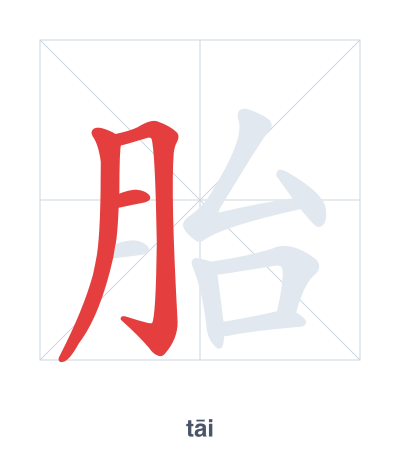
Open Hanzi Writer to see the animated stroke order and practice writing 胎 with real-time feedback.
The character 胎 (tāi) is written with 9 strokes. Follow the standard Chinese stroke order: top to bottom, left to right, outside before inside. The radical ⺼ is one of its key components.
Practice the correct stroke order with the Hanzi Writer app to see animated stroke-by-stroke guidance with real-time feedback.
胎 means Fetus / Tire.
As an HSK Level 7 character, 胎 is an intermediate-level character.
胎 combines the flesh radical ⺼ (月) with the phonetic component 台 (platform/terrace). The flesh radical indicates the body, and the whole character originally referred to the embryo in the womb; later it was also borrowed to mean 'tire' due to phonetic similarity.
💡 Memory Tip: Imagine a tiny fetus resting on a platform (台), surrounded by fleshy (⺼) protection.
汽车行驶前应该检查一下轮胎的气压是否正常。
qì chē xíng shǐ qián yīng gāi jiǎn chá yī xià lún tāi de qì yā shì fǒu zhèng cháng 。
Before driving, you should check if the tire pressure is normal.
他们是双胞胎。
tā men shì shuāng bāo tāi
They are twins.
胚胎发育很快。
pēi tāi fà yù hěn kuài
The embryo develops very quickly.
Open Hanzi Writer to see the animated stroke order and practice writing 胎 with real-time feedback.
✨ Animated stroke order · Handwriting recognition · HSK-graded practice · Free to use
胎 is composed of the radical ⺼ (meat/month) on the left and 台 (tái, platform/terrace) on the right. The meat radical relates to the body or flesh, and 台 provides the pronunciation tāi, together forming the meaning 'fetus' (a developing body inside a mother). For the tire meaning, it is a borrowed use because the Chinese word for tire came from a similar-sounding English word and was written with 胎.