啚 (bǐ) means "Mean; low; vulgar" in Chinese. It has 11 strokes with the radical 口.
Rated 4.2/5 in difficulty (advanced).
Appears in 3+ common words including 啚夫 (bǐ fū), 啚野 (bǐ yě), 啚贱 (bǐ jiàn).
Due to its 11 strokes, Hanzi Writer's error detection shows 啚 requires focused practice — most learners need 10+ attempts for consistent accuracy.
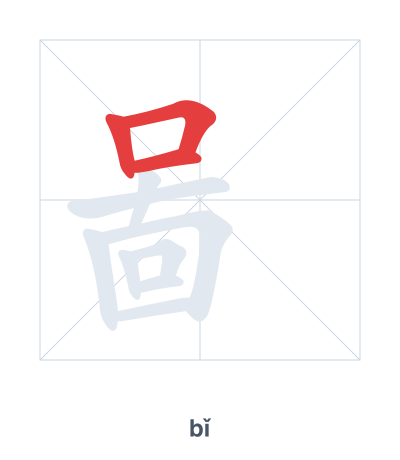
Open Hanzi Writer to see the animated stroke order and practice writing 啚 with real-time feedback.
The character 啚 (bǐ) is written with 11 strokes. Follow the standard Chinese stroke order: top to bottom, left to right, outside before inside. The radical 口 is one of its key components.
Practice the correct stroke order with the Hanzi Writer app to see animated stroke-by-stroke guidance with real-time feedback.
啚 means Mean; low; vulgar.
啚 originally depicted a granary or storehouse, composed of 口 (an enclosure) and 㕣 (a pictograph of a storage pit). Over time, it was borrowed to mean 'mean, low, vulgar' because such rustic border storehouses were associated with lowly people. It later became the ancient form of 鄙 (bǐ), which carries the same meaning.
💡 Memory Tip: Imagine a mouth (口) saying 'bǐ' while a rude person (㕣 looks like a bent-over figure) makes a vulgar gesture.
他是一个啚夫。
tā shì yí gè bǐ fū
He is a vulgar person.
这个地方很啚野。
zhè ge dì fāng hěn bǐ yě
This place is very rustic.
这种行为很啚贱。
zhè zhǒng xíng wéi hěn bǐ jiàn
This behavior is very mean and lowly.
Open Hanzi Writer to see the animated stroke order and practice writing 啚 with real-time feedback.
✨ Animated stroke order · Handwriting recognition · HSK-graded practice · Free to use
啚 has the radical 口 (mouth) on top and a lower component 㕣, which originally meant a valley or flowing water. Together, they suggest speaking in a coarse or low manner, reflecting the character's meaning of mean or vulgar.