野 (yě) means "Wild; field" in Chinese. It has 11 strokes with the radical 里, and is HSK Level 6.
Rated 4.2/5 in difficulty (advanced).
Harder than 96% of HSK Level 6 characters.
Appears in 3+ common words including 野餐 (yě cān), 野生 (yě shēng), 野外 (yě wài).
Due to its 11 strokes, Hanzi Writer's error detection shows 野 requires focused practice — most learners need 10+ attempts for consistent accuracy.
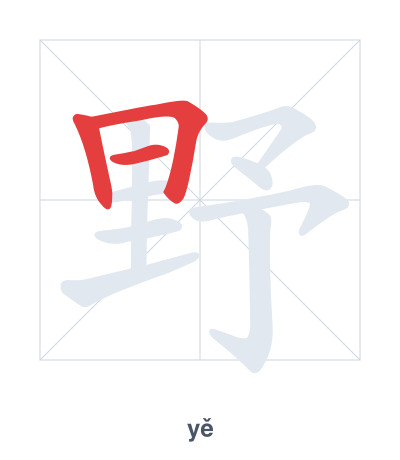
Open Hanzi Writer to see the animated stroke order and practice writing 野 with real-time feedback.
The character 野 (yě) is written with 11 strokes. Follow the standard Chinese stroke order: top to bottom, left to right, outside before inside. The radical 里 is one of its key components.
Practice the correct stroke order with the Hanzi Writer app to see animated stroke-by-stroke guidance with real-time feedback.
野 means Wild; field.
As an HSK Level 6 character, 野 is an intermediate-level character.
Originally, 野 depicted a forest (林) over earth (土), representing untamed land outside villages. Over time, it evolved into the current form with 里 (village) on the left and 予 (give) on the right, suggesting land 'given over' to wildness beyond the village.
💡 Memory Tip: Imagine the village (里) giving (予) you a wild field to explore, with tall grass and roaming animals.
周末我们去野餐吧。
zhōu mò wǒ men qù yě cān ba
Let's go for a picnic this weekend.
森林里有野生动物。
sēn lín lǐ yǒu yě shēng dòng wù
There are wild animals in the forest.
我们去野外露营。
wǒ men qù yě wài lù yíng
We are going camping in the wild.
Open Hanzi Writer to see the animated stroke order and practice writing 野 with real-time feedback.
✨ Animated stroke order · Handwriting recognition · HSK-graded practice · Free to use
Left side 里 means 'field' or 'village', and right side 予 adds the sound yǔ. Together, they suggest the area beyond cultivated fields, which is wild or untamed.