捆 (kǔn) means "to tie or bundle" in Chinese. It has 10 strokes with the radical 扌, and is HSK Level 7.
Rated 4.2/5 in difficulty (advanced).
Harder than 58% of HSK Level 7 characters.
Appears in 3+ common words including 捆绑 (kǔn bǎng), 一捆 (yī kǔn), 捆好 (kǔn hǎo).
Due to its 10 strokes, Hanzi Writer's error detection shows 捆 requires focused practice — most learners need 10+ attempts for consistent accuracy.
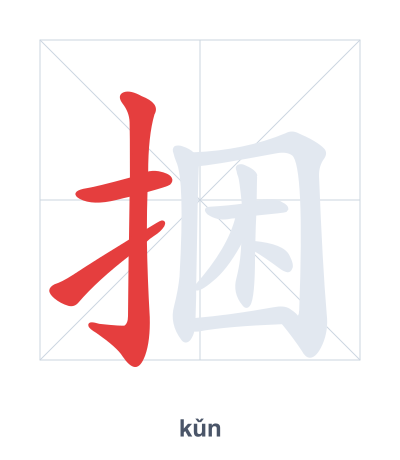
Open Hanzi Writer to see the animated stroke order and practice writing 捆 with real-time feedback.
The character 捆 (kǔn) is written with 10 strokes. Follow the standard Chinese stroke order: top to bottom, left to right, outside before inside. The radical 扌 is one of its key components.
Practice the correct stroke order with the Hanzi Writer app to see animated stroke-by-stroke guidance with real-time feedback.
捆 means to tie or bundle.
As an HSK Level 7 character, 捆 is an intermediate-level character.
The character 捆 combines the hand radical 扌 with the phonetic component 困 (kùn, meaning 'to surround' or 'distress'). 困 itself shows a tree (木) inside an enclosure (囗), suggesting something trapped or encircled. Together, 扌 and 困 depict the action of using hands to bind or tie up something, like bundling it securely.
💡 Memory Tip: Picture a hand (扌) tying ropes around a tree (木) trapped inside a square enclosure (囗) to make a tight bundle.
把这些旧报纸捆绑好。
bǎ zhè xiē jiù bào zhǐ kǔn bǎng hǎo
Tie up these old newspapers.
地上有一捆木柴。
dì shàng yǒu yī kǔn mù chái
There is a bundle of firewood on the ground.
在出发旅行前,请务必把车顶的行李捆好。
zài chū fā lǚ xíng qián , qǐng wù bì bǎ chē dǐng de xíng lǐ kǔn hǎo 。
Before setting off on a trip, please make sure to tie down the luggage on the roof of the car.
Open Hanzi Writer to see the animated stroke order and practice writing 捆 with real-time feedback.
✨ Animated stroke order · Handwriting recognition · HSK-graded practice · Free to use
The character 捆 combines the radical 扌 (hand) on the left, indicating an action done with the hand, and the phonetic component 困 (kùn) on the right, which suggests the sound and also means "to trap or encircle." Together, they convey using the hand to trap or encircle something tightly — hence "to tie or bundle."