腕 (wàn) means "Wrist" in Chinese. It has 12 strokes with the radical 月, and is HSK Level 7.
Rated 4.2/5 in difficulty (advanced).
Harder than 83% of HSK Level 7 characters.
Appears in 3+ common words including 手腕 (shǒu wàn), 护腕 (hù wàn), 腕力 (wàn lì).
Due to its 12 strokes, Hanzi Writer's error detection shows 腕 requires focused practice — most learners need 10+ attempts for consistent accuracy.
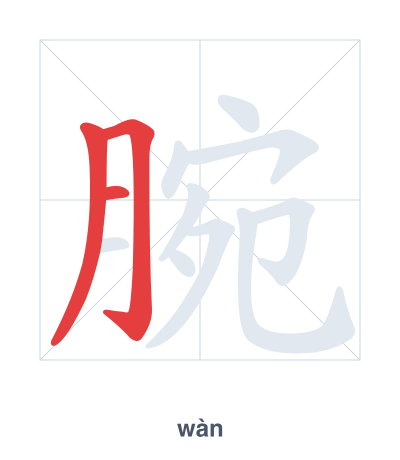
Open Hanzi Writer to see the animated stroke order and practice writing 腕 with real-time feedback.
The character 腕 (wàn) is written with 12 strokes. Follow the standard Chinese stroke order: top to bottom, left to right, outside before inside. The radical 月 is one of its key components.
Practice the correct stroke order with the Hanzi Writer app to see animated stroke-by-stroke guidance with real-time feedback.
腕 means Wrist.
As an HSK Level 7 character, 腕 is an intermediate-level character.
腕 combines the flesh radical 月 (indicating a body part) with 宛 (winding or curved), together suggesting the flexible, curved joint that connects hand and arm. The wrist is the bendable part where the arm narrows before the hand.
💡 Memory Tip: Picture a meaty (月) section of your arm that bends (宛) like a snake—that's your wrist.
他的手腕受伤了。
tā de shǒu wàn shòu shāng le
His wrist is injured.
运动时要戴护腕。
yùn dòng shí yào dài hù wàn
Wear wrist guards when exercising.
他的腕力非常大。
tā de wàn lì fēi cháng dà
His wrist strength is very great.
Open Hanzi Writer to see the animated stroke order and practice writing 腕 with real-time feedback.
✨ Animated stroke order · Handwriting recognition · HSK-graded practice · Free to use
The character 腕 has the radical 月 (肉), which represents flesh or body parts, and the phonetic component 宛. Together, they indicate a part of the body near the hand, specifically the wrist.