篹 (zhuàn) means "to compile" in Chinese. It has 16 strokes with the radical 竹.
Rated 3.9/5 in difficulty (challenging).
Appears in 3+ common words including 篹录 (zhuàn lù), 篹述 (zhuàn shù), 篹集 (zhuàn jí).
Due to its 16 strokes, Hanzi Writer's error detection shows 篹 requires focused practice — most learners need 10+ attempts for consistent accuracy.
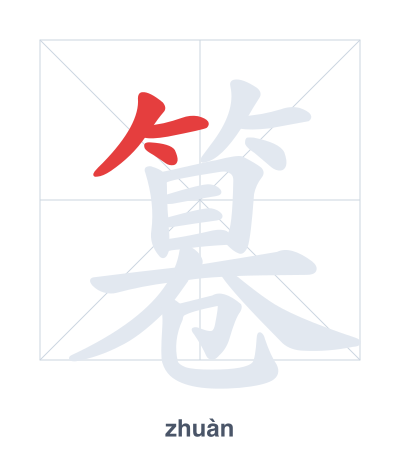
Open Hanzi Writer to see the animated stroke order and practice writing 篹 with real-time feedback.
The character 篹 (zhuàn) is written with 16 strokes. Follow the standard Chinese stroke order: top to bottom, left to right, outside before inside. The radical 竹 is one of its key components.
Practice the correct stroke order with the Hanzi Writer app to see animated stroke-by-stroke guidance with real-time feedback.
篹 means to compile.
The character 篹 combines 竹 (bamboo, representing ancient writing slips) with 巽 (a component suggesting compliance or orderly arrangement), together depicting the act of gathering and organizing bamboo slips into a compiled text.
💡 Memory Tip: Imagine a scribe stacking bamboo slips (竹) in a neat pile that forms the shape of a spiral (巽), assembling them into a compiled record.
他在篹录古书。
tā zài zhuàn lù gǔ shū
He is compiling ancient books.
这本书由他篹述。
zhè běn shū yóu tā zhuàn shù
This book was compiled by him.
他们在篹集资料。
tā men zài zhuàn jí zī liào
They are compiling information.
Open Hanzi Writer to see the animated stroke order and practice writing 篹 with real-time feedback.
✨ Animated stroke order · Handwriting recognition · HSK-graded practice · Free to use
篹 is made of 竹 (bamboo) on top and 算 (to calculate) below. The bamboo radical hints at writing materials like bamboo slips, and 算 suggests numbers or records, together indicating compiling written information.