篆 (zhuàn) means "seal script" in Chinese. It has 15 strokes with the radical 竹.
Rated 4.2/5 in difficulty (advanced).
Appears in 3+ common words including 篆书 (zhuàn shū), 篆刻 (zhuàn kè), 小篆 (xiǎo zhuàn).
Due to its 15 strokes, Hanzi Writer's error detection shows 篆 requires focused practice — most learners need 10+ attempts for consistent accuracy.
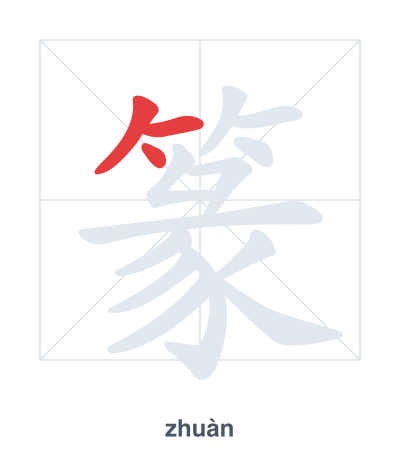
Open Hanzi Writer to see the animated stroke order and practice writing 篆 with real-time feedback.
The character 篆 (zhuàn) is written with 15 strokes. Follow the standard Chinese stroke order: top to bottom, left to right, outside before inside. The radical 竹 is one of its key components.
Practice the correct stroke order with the Hanzi Writer app to see animated stroke-by-stroke guidance with real-time feedback.
篆 means seal script.
篆 is a phono-semantic compound: the radical 竹 (bamboo) represents the material of early writing slips, while 彖 (tuàn) provides the sound and originally referred to ornate, interpretive inscriptions—together they evoke the elegant, carved strokes of seal script used on bamboo seals and documents.
💡 Memory Tip: Picture a bamboo brush (竹) carving intricate seal-script lines into a pig-shaped seal (彖), its curly tail mimicking the decorative curves of the characters.
他在写篆书。
tā zài xiě zhuàn shū
He is writing in seal script.
他喜欢篆刻。
tā xǐ huān zhuàn kè
He likes seal carving.
小篆是一种字体。
xiǎo zhuàn shì yī zhǒng zì tǐ
Small Seal Script is a type of font.
Open Hanzi Writer to see the animated stroke order and practice writing 篆 with real-time feedback.
✨ Animated stroke order · Handwriting recognition · HSK-graded practice · Free to use
The character 篆 is composed of 竹 (bamboo) on top and 彖 (a phonetic component) below. The bamboo radical relates to ancient writing materials, as seal script was often written on bamboo slips. The overall meaning 'seal script' comes from this connection to early writing methods.