刻 (kè) means "to carve; quarter (of an hour)" in Chinese. It has 8 strokes with the radical 刂, and is HSK Level 2.
Rated 2.9/5 in difficulty (moderate).
Harder than 34% of HSK Level 2 characters.
Appears in 3+ common words including 刻苦 (kè kǔ), 立刻 (lì kè), 一刻钟 (yī kè zhōng).
Hanzi Writer's stroke validation shows learners typically need 5-8 attempts to write 刻 with correct proportion and order.
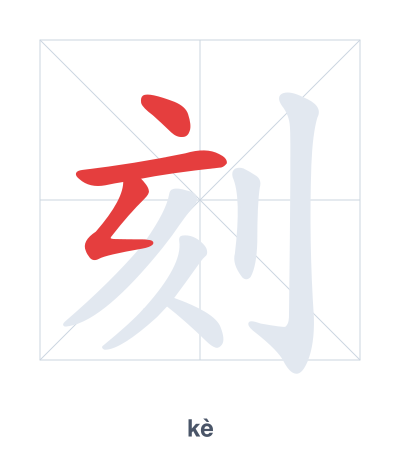
Open Hanzi Writer to see the animated stroke order and practice writing 刻 with real-time feedback.
The character 刻 (kè) is written with 8 strokes. Follow the standard Chinese stroke order: top to bottom, left to right, outside before inside. The radical 刂 is one of its key components.
Practice the correct stroke order with the Hanzi Writer app to see animated stroke-by-stroke guidance with real-time feedback.
刻 means to carve; quarter (of an hour).
As an HSK Level 2 character, 刻 is among the first characters beginners learn.
刻 combines the phonetic component 亥 (hài, originally a pictograph of a pig or root) with the knife radical 刂 (刀), indicating the action of cutting or carving into a surface. The secondary meaning 'quarter of an hour' comes from ancient timekeeping, where a carved notch on a water clock marked each quarter-hour interval.
💡 Memory Tip: Imagine a knife (刂) carving a notch into the side of a water clock—the figure 亥 on the left looks like the clock's markings, and each carved line marks a quarter hour.
他学习非常刻苦。
tā xué xí fēi cháng kè kǔ
He studies very hard.
请立刻到办公室来。
qǐng lì kè dào bàn gōng shì lái
Please come to the office immediately.
他在雨中撑着伞等了足足一刻钟。
tā zài yǔ zhōng chēng zhe sǎn děng le zú zú yī kè zhōng 。
He waited in the rain with an umbrella for a full quarter of an hour.
Open Hanzi Writer to see the animated stroke order and practice writing 刻 with real-time feedback.
✨ Animated stroke order · Handwriting recognition · HSK-graded practice · Free to use
刻 is composed of 亥 on the left and 刂 (knife radical) on the right. The knife radical suggests cutting or carving, while 亥 provides a phonetic hint (though its pronunciation differs). Together they form the ideas of carving with a knife and also the time unit "quarter of an hour" (from ancient timekeeping).