祝 (zhù) means "To wish" in Chinese. It has 9 strokes with the radical 礻, and is HSK Level 3.
Rated 4/5 in difficulty (challenging).
Harder than 66% of HSK Level 3 characters.
Appears in 3+ common words including 祝贺 (zhù hè), 祝福 (zhù fú), 庆祝 (qìng zhù).
Due to its 9 strokes, Hanzi Writer's error detection shows 祝 requires focused practice — most learners need 10+ attempts for consistent accuracy.
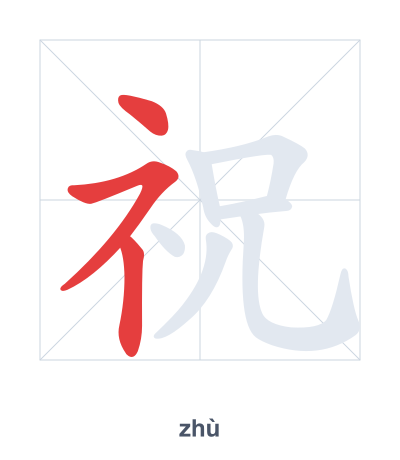
Open Hanzi Writer to see the animated stroke order and practice writing 祝 with real-time feedback.
The character 祝 (zhù) is written with 9 strokes. Follow the standard Chinese stroke order: top to bottom, left to right, outside before inside. The radical 礻 is one of its key components.
Practice the correct stroke order with the Hanzi Writer app to see animated stroke-by-stroke guidance with real-time feedback.
祝 means To wish.
As an HSK Level 3 character, 祝 is an intermediate-level character.
祝 combines the radical 礻 (示, meaning 'altar' or 'spirit') with 兄 (an elder brother figure kneeling and speaking with an open mouth). In ancient form, it depicted a person praying before a shrine, conveying the act of expressing wishes or blessings to the spirits.
💡 Memory Tip: Imagine an elder brother (兄) kneeling at an altar (礻) and fervently wishing for a gift.
祝贺你毕业了。
zhù hè nǐ bì yè le
Congratulations on your graduation.
送上我最好的祝福。
sòng shàng wǒ zuì hǎo de zhù fú
Sending my best wishes.
我们一起庆祝生日。
wǒ men yì qǐ qìng zhù shēng rì
We celebrate birthdays together.
Open Hanzi Writer to see the animated stroke order and practice writing 祝 with real-time feedback.
✨ Animated stroke order · Handwriting recognition · HSK-graded practice · Free to use
祝 is made of the radical 礻 on the left, which represents an altar or spirit, and 兄 on the right, which gives the sound zhù. Together, 礻 indicates the meaning relates to prayer or blessing, so 祝 means "to wish" or "to pray."