痣 (zhì) means "mole; nevus" in Chinese. It has 12 strokes with the radical 疒.
Rated 4.2/5 in difficulty (advanced).
Appears in 3+ common words including 黑痣 (hēi zhì), 去痣 (qù zhì), 长痣 (zhǎng zhì).
Due to its 12 strokes, Hanzi Writer's error detection shows 痣 requires focused practice — most learners need 10+ attempts for consistent accuracy.
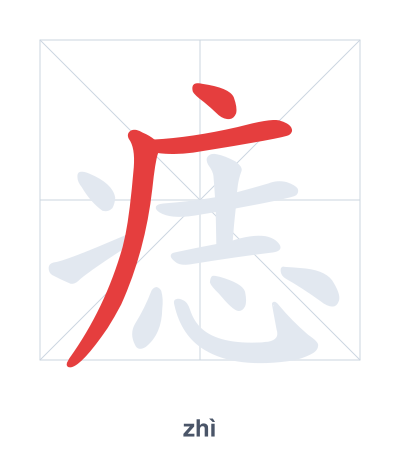
Open Hanzi Writer to see the animated stroke order and practice writing 痣 with real-time feedback.
The character 痣 (zhì) is written with 12 strokes. Follow the standard Chinese stroke order: top to bottom, left to right, outside before inside. The radical 疒 is one of its key components.
Practice the correct stroke order with the Hanzi Writer app to see animated stroke-by-stroke guidance with real-time feedback.
痣 means mole; nevus.
痣 is a phono-semantic compound: the radical 疒 (illness) indicates a skin condition, while 志 (meaning 'mark' or 'aspiration') provides the pronunciation and hints that a mole is a distinctive mark on the body. Together, they depict a growth or spot on the skin considered a minor ailment or blemish.
💡 Memory Tip: Imagine a sick person (疒) lying in bed, obsessively staring at a tiny heart-shaped mole (志) on their arm.
他脸上有一颗黑痣。
tā liǎn shàng yǒu yī kē hēi zhì
He has a black mole on his face.
她想去医院去痣。
tā xiǎng qù yī yuàn qù zhì
She wants to go to the hospital to have a mole removed.
他的后背长了一颗痣。
tā de hòu bèi zhǎng le yī kē zhì
He has a mole on his back.
Open Hanzi Writer to see the animated stroke order and practice writing 痣 with real-time feedback.
✨ Animated stroke order · Handwriting recognition · HSK-graded practice · Free to use
痣 is composed of the radical 疒 (sickness) on the left and the phonetic component 志 (record/ambition) on the right. The radical 疒 indicates that a mole is a skin condition or blemish, while 志 provides the pronunciation and adds the idea of a 'mark' that remains on the skin.