确 (què) means "certain / sure" in Chinese. It has 12 strokes with the radical 石, and is HSK Level 2.
Rated 3.7/5 in difficulty (challenging).
Harder than 87% of HSK Level 2 characters.
Appears in 3+ common words including 确定 (què dìng), 正确 (zhèng què), 确实 (què shí).
Due to its 12 strokes, Hanzi Writer's error detection shows 确 requires focused practice — most learners need 10+ attempts for consistent accuracy.
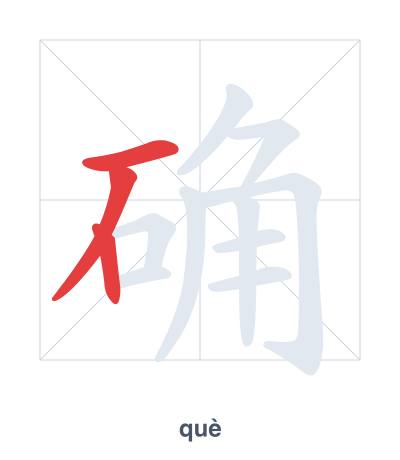
Open Hanzi Writer to see the animated stroke order and practice writing 确 with real-time feedback.
The character 确 (què) is written with 12 strokes. Follow the standard Chinese stroke order: top to bottom, left to right, outside before inside. The radical 石 is one of its key components.
Practice the correct stroke order with the Hanzi Writer app to see animated stroke-by-stroke guidance with real-time feedback.
确 means certain / sure.
As an HSK Level 2 character, 确 is among the first characters beginners learn.
The character 确 is the simplified form of 確, which combines the radical 石 (stone, symbolizing hardness) with 隺 (meaning 'firm'). Together, they depict something solid and unyielding, thus conveying the sense of 'certain' or 'sure'.
💡 Memory Tip: Picture a stone (石) with a horn (角) sticking out of it — you can be certain that rock is hard.
你确定要去吗?
nǐ què dìng yào qù ma
Are you sure you want to go?
你的回答很正确。
nǐ de huí dá hěn zhèng què
Your answer is correct.
今天确实很冷。
jīn tiān què shí hěn lěng
It is indeed very cold today.
Open Hanzi Writer to see the animated stroke order and practice writing 确 with real-time feedback.
✨ Animated stroke order · Handwriting recognition · HSK-graded practice · Free to use
The left side is the radical 石 (stone), which suggests hardness and solidity, linking to the meaning 'certain' or 'sure'. The right side is 角 (horn), which likely provides the pronunciation 'què' in this character.