蘸 (zhàn) means "to dip (in liquid or sauce)" in Chinese. It has 22 strokes with the radical 艹, and is HSK Level 7.
Rated 4.2/5 in difficulty (advanced).
Harder than 88% of HSK Level 7 characters.
Appears in 3+ common words including 蘸酱 (zhàn jiàng), 蘸水 (zhàn shuǐ), 蘸醋 (zhàn cù).
Due to its 22 strokes, Hanzi Writer's error detection shows 蘸 requires focused practice — most learners need 10+ attempts for consistent accuracy.
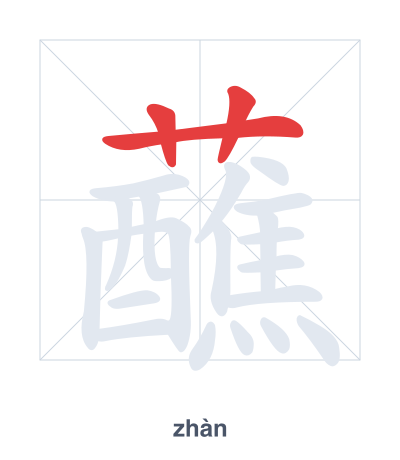
Open Hanzi Writer to see the animated stroke order and practice writing 蘸 with real-time feedback.
The character 蘸 (zhàn) is written with 22 strokes. Follow the standard Chinese stroke order: top to bottom, left to right, outside before inside. The radical 艹 is one of its key components.
Practice the correct stroke order with the Hanzi Writer app to see animated stroke-by-stroke guidance with real-time feedback.
蘸 means to dip (in liquid or sauce).
As an HSK Level 7 character, 蘸 is an intermediate-level character.
蘸 combines the grass radical (艹) with 醮, which originally referred to a libation ceremony. Together they depict the action of dipping herbs or vegetables into a liquid or sauce, as in preparing food for a ritual offering.
💡 Memory Tip: Imagine a blade of grass (艹) being dipped into a steaming pot of wine (酉) until it sizzles (焦)—that's dipping!
饺子要蘸酱吃。
jiǎo zi yào zhàn jiàng chī
Dumplings should be eaten with dipping sauce.
毛笔要蘸水。
máo bǐ yào zhàn shuǐ
The writing brush needs to be dipped in water.
我喜欢蘸醋吃包子。
wǒ xǐ huān zhàn cù chī bāo zi
I like dipping steamed buns in vinegar.
Open Hanzi Writer to see the animated stroke order and practice writing 蘸 with real-time feedback.
✨ Animated stroke order · Handwriting recognition · HSK-graded practice · Free to use
蘸 has the grass radical 艹 on top, with 酉 (wine jar) on the lower left and 焦 (burn) on the lower right. Together, these components suggest dipping something into a liquid — 酉 represents the sauce or liquid, and 焦 hints at the action of immersing or touching.