蘘 (ráng) means "wild ginger" in Chinese. It has 21 strokes with the radical 艹.
Rated 4.2/5 in difficulty (advanced).
Appears in 3+ common words including 蘘荷 (ráng hé), 蘘草 (ráng cǎo), 蘘子 (ráng zi).
Due to its 21 strokes, Hanzi Writer's error detection shows 蘘 requires focused practice — most learners need 10+ attempts for consistent accuracy.
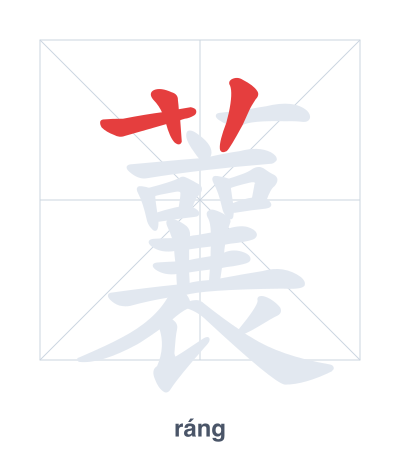
Open Hanzi Writer to see the animated stroke order and practice writing 蘘 with real-time feedback.
The character 蘘 (ráng) is written with 21 strokes. Follow the standard Chinese stroke order: top to bottom, left to right, outside before inside. The radical 艹 is one of its key components.
Practice the correct stroke order with the Hanzi Writer app to see animated stroke-by-stroke guidance with real-time feedback.
蘘 means wild ginger.
蘘 is a phono-semantic compound: the radical 艹 indicates it's a plant (wild ginger), while 襄 contributes the pronunciation ráng. The bottom part 襄, meaning 'to assist', does not relate directly to the plant's meaning but some scholars suggest its complex structure evokes the layered leaves of wild ginger rhizomes.
💡 Memory Tip: Imagine a wild ginger plant with 21 leaves arranged in a pattern that looks like a dancer (襄) wearing grass (艹) on their head.
园子里种了蘘荷。
yuán zi lǐ zhǒng le ráng hé
Myoga ginger is planted in the garden.
这种蘘草很常见。
zhè zhǒng ráng cǎo hěn cháng jiàn
This ginger plant is very common.
蘘子可以入药。
ráng zi kě yǐ rù yào
Wild ginger fruit can be used as medicine.
Open Hanzi Writer to see the animated stroke order and practice writing 蘘 with real-time feedback.
✨ Animated stroke order · Handwriting recognition · HSK-graded practice · Free to use
The character 蘘 is made of two parts: the top radical 艹 (grass) and the bottom part 襄 (xiāng). The radical 艹 shows that this character is related to plants, specifically wild ginger. The bottom part 襄 provides the pronunciation ráng and does not directly relate to the plant's meaning.