蘼 (mí) means "millet; fragrant grass" in Chinese. It has 22 strokes with the radical 艹.
Rated 4.2/5 in difficulty (advanced).
Appears in 3+ common words including 荼蘼 (tú mí), 蘼芜 (mí wú), 蘼草 (mí cǎo).
Due to its 22 strokes, Hanzi Writer's error detection shows 蘼 requires focused practice — most learners need 10+ attempts for consistent accuracy.
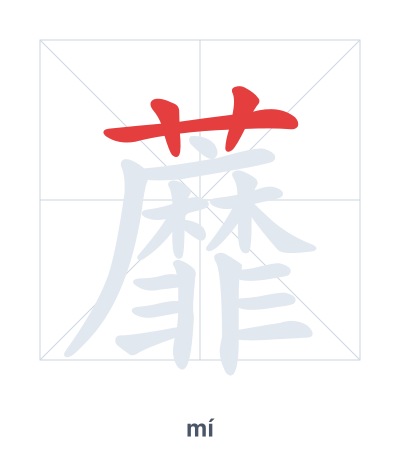
Open Hanzi Writer to see the animated stroke order and practice writing 蘼 with real-time feedback.
The character 蘼 (mí) is written with 22 strokes. Follow the standard Chinese stroke order: top to bottom, left to right, outside before inside. The radical 艹 is one of its key components.
Practice the correct stroke order with the Hanzi Writer app to see animated stroke-by-stroke guidance with real-time feedback.
蘼 means millet; fragrant grass.
This compound character combines the grass radical 艹 with 靡 (mí) as a phonetic component. The grass radical indicates it is a type of plant, while 靡 contributes the pronunciation and a connotation of 'luxuriant spreading,' describing how fragrant grass grows abundantly.
💡 Memory Tip: Picture a patch of fragrant grass (艹) so overgrown it's 'wasting' and spreading everywhere like a messy pile (靡) — that's 蘼.
荼蘼花在春天开放。
tú mí huā zài chūn tiān kāi fàng
The blackberry rose blooms in spring.
蘼芜是一种香草。
mí wú shì yī zhǒng xiāng cǎo
Miwu is a type of fragrant herb.
山坡上长满了蘼草。
shān pō shàng zhǎng mǎn le mí cǎo
The hillside is covered with fragrant grass.
Open Hanzi Writer to see the animated stroke order and practice writing 蘼 with real-time feedback.
✨ Animated stroke order · Handwriting recognition · HSK-graded practice · Free to use
蘼 is composed of the grass radical 艹 on top, indicating it relates to plants, and a phonetic component 靡 (mí) below. The grass radical directly connects to its meanings of "fragrant grass" or "millet," while 靡 provides the pronunciation but also carries a sense of spreading or lush growth.