蘵 (zhī) means "physalis; groundcherry" in Chinese. It has 22 strokes with the radical 艹.
Rated 4.2/5 in difficulty (advanced).
Appears in 3+ common words including 苦蘵 (kǔ zhī), 蘵草 (zhī cǎo), 蘵子 (zhī zi).
Due to its 22 strokes, Hanzi Writer's error detection shows 蘵 requires focused practice — most learners need 10+ attempts for consistent accuracy.
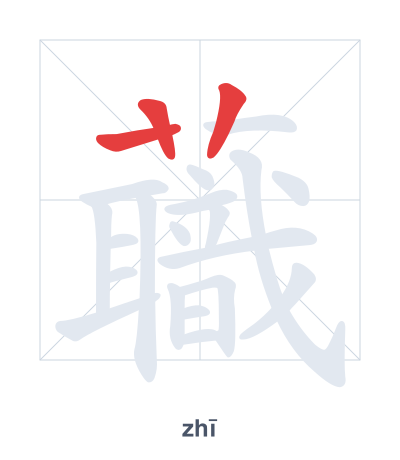
Open Hanzi Writer to see the animated stroke order and practice writing 蘵 with real-time feedback.
The character 蘵 (zhī) is written with 22 strokes. Follow the standard Chinese stroke order: top to bottom, left to right, outside before inside. The radical 艹 is one of its key components.
Practice the correct stroke order with the Hanzi Writer app to see animated stroke-by-stroke guidance with real-time feedback.
蘵 means physalis; groundcherry.
蘵 is a phono-semantic compound. The radical 艹 (grass) marks it as a plant, while 戠 (zhí) provides the pronunciation. Groundcherries are small fruit enclosed in a papery husk, like a lantern.
💡 Memory Tip: Picture a groundcherry plant (艹) where each fruit is a tiny lantern with a spear (戈) inside that squeaks 'zhī' when shaken.
苦蘵是一种植物。
kǔ zhī shì yī zhǒng zhí wù
Husk tomato is a type of plant.
地上长满了蘵草。
dì shàng zhǎng mǎn le zhī cǎo
The ground is covered with ground cherry plants.
蘵子结了很多果。
zhī zi jié le hěn duō guǒ
The physalis plant has produced many fruits.
Open Hanzi Writer to see the animated stroke order and practice writing 蘵 with real-time feedback.
✨ Animated stroke order · Handwriting recognition · HSK-graded practice · Free to use
蘵 is composed of the radical 艹 (grass) on top, indicating it is a plant, and the component 戠 (zhī) underneath, which gives the character its pronunciation. The grass radical tells you this character relates to a plant, while the phonetic part 戠 helps you say the sound "zhī." Together they form the name of the physalis or groundcherry plant.