谵 (zhān) means "delirious talk" in Chinese. It has 15 strokes with the radical 讠.
Rated 3.9/5 in difficulty (challenging).
Appears in 3+ common words including 谵语 (zhān yǔ), 谵妄 (zhān wàng), 狂谵 (kuáng zhān).
Due to its 15 strokes, Hanzi Writer's error detection shows 谵 requires focused practice — most learners need 10+ attempts for consistent accuracy.
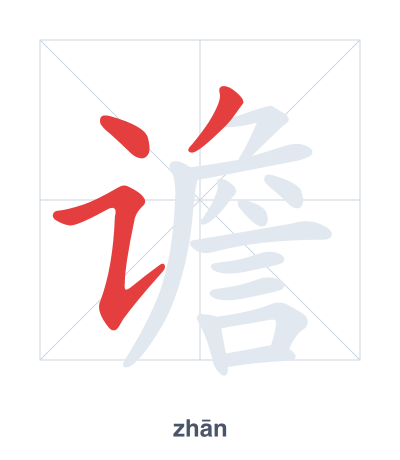
Open Hanzi Writer to see the animated stroke order and practice writing 谵 with real-time feedback.
The character 谵 (zhān) is written with 15 strokes. Follow the standard Chinese stroke order: top to bottom, left to right, outside before inside. The radical 讠 is one of its key components.
Practice the correct stroke order with the Hanzi Writer app to see animated stroke-by-stroke guidance with real-time feedback.
谵 means delirious talk.
This compound character combines the speech radical 讠 (words) with the phonetic component 詹 (zhān), which originally depicted excessive or verbose talking. Together, they represent speech that is rambling and incoherent, as in delirious talk.
💡 Memory Tip: Imagine a person on a rooftop (厃) babbling eight (八) nonsensical phrases (言) inside a speech bubble (讠) — that's delirious talk.
病人在昏迷中说谵语。
bìng rén zài hūn mí zhōng shuō zhān yǔ
The patient is talking deliriously in a coma.
他现在处于谵妄状态。
tā xiàn zài chǔ yú zhān wàng zhuàng tài
He is currently in a state of delirium.
他的样子看起来很狂谵。
tā de yàng zi kàn qǐ lái hěn kuáng zhān
He looks very delirious.
Open Hanzi Writer to see the animated stroke order and practice writing 谵 with real-time feedback.
✨ Animated stroke order · Handwriting recognition · HSK-graded practice · Free to use
The character 谵 has the radical 讠 (speech) on the left, showing it is about speaking. The right part 詹 gives the pronunciation zhān and also suggests confused or excessive talk, because 詹 contains elements meaning "danger" and "speech" inside itself.