再 (zài) means "again; once more" in Chinese. It has 6 strokes with the radical 冂, and is HSK Level 1.
Rated 2.4/5 in difficulty (moderate).
Harder than 29% of HSK Level 1 characters.
Appears in 3+ common words including 再见 (zài jiàn), 再说 (zài shuō), 再一次 (zài yí cì).
Hanzi Writer's stroke validation shows learners typically need 5-8 attempts to write 再 with correct proportion and order.
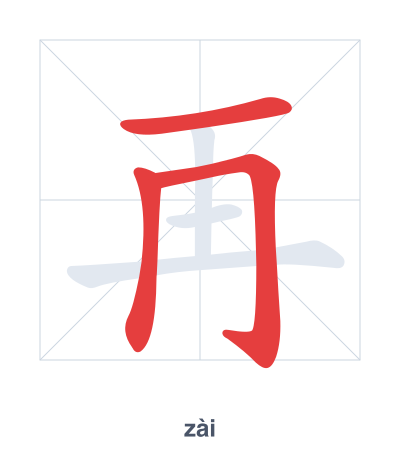
Open Hanzi Writer to see the animated stroke order and practice writing 再 with real-time feedback.
The character 再 (zài) is written with 6 strokes. Follow the standard Chinese stroke order: top to bottom, left to right, outside before inside. The radical 冂 is one of its key components.
Practice the correct stroke order with the Hanzi Writer app to see animated stroke-by-stroke guidance with real-time feedback.
再 means again; once more.
As an HSK Level 1 character, 再 is among the first characters beginners learn.
In ancient script, 再 depicted a doubled image, often interpreted as two fish or a repeated action, symbolizing 'again' or 'a second time'. The modern form combines a horizontal stroke (一) inside an enclosure (冂), suggesting something is placed or occurs twice.
💡 Memory Tip: Imagine a door (冂) with a horizontal bar (一) across it—you have to push again to get through.
老师,再见!
lǎo shī zài jiàn
Goodbye, teacher!
我们明天再说吧。
wǒ men míng tiān zài shuō ba
Let's talk about it tomorrow.
他再一次向大家展示了精湛的琴艺。
tā zài yí cì xiàng dà jiā zhǎn shì le jīng zhàn de qín yì 。
He once again demonstrated his superb piano skills to everyone.
Open Hanzi Writer to see the animated stroke order and practice writing 再 with real-time feedback.
✨ Animated stroke order · Handwriting recognition · HSK-graded practice · Free to use
再 is composed of the radical 冂 (a frame or enclosure) on top and a simplified form of 一 (one) with a stroke below. The structure suggests something being enclosed or repeated, which connects to the idea of doing something 'again' or 'once more'.