冏 (jiǒng) means "Bright / embarrassed" in Chinese. It has 7 strokes with the radical 冂.
Rated 3.2/5 in difficulty (challenging).
Appears in 1+ common words including 冏 (jiǒng).
Due to its 7 strokes, Hanzi Writer's error detection shows 冏 requires focused practice — most learners need 10+ attempts for consistent accuracy.
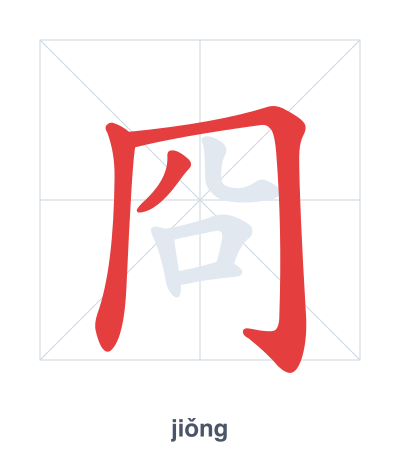
Open Hanzi Writer to see the animated stroke order and practice writing 冏 with real-time feedback.
The character 冏 (jiǒng) is written with 7 strokes. Follow the standard Chinese stroke order: top to bottom, left to right, outside before inside. The radical 冂 is one of its key components.
Practice the correct stroke order with the Hanzi Writer app to see animated stroke-by-stroke guidance with real-time feedback.
冏 means Bright / embarrassed.
| Character | 冏 |
| Pinyin | jiǒng (jiong) |
| Meaning | Bright / embarrassed |
| Strokes | 7 |
| Radical | 冂 |
| Difficulty | 3.2/5 |
The character 冏 originally depicted a window or skylight, with the outer frame 冂 and interior lines representing light streaming through, hence the meaning 'bright'. Over time, its shape came to resemble a startled or embarrassed face, giving it a secondary meaning of 'embarrassed'.
💡 Memory Tip: Imagine a face with wide eyes and a gaping mouth (the shape of 冏) blushing bright red from embarrassment.
他觉得很冏。
tā jué de hěn jiǒng
He felt very embarrassed.
这个表情很冏。
zhè ge biǎo qíng hěn jiǒng
This expression is very awkward.
大家都笑了。
dà jiā dōu xiào le
Everyone laughed.
Open Hanzi Writer to see the animated stroke order and practice writing 冏 with real-time feedback.
✨ Animated stroke order · Handwriting recognition · HSK-graded practice · Free to use
The character 冏 is built with the radical 冂 (a wide enclosure) on the outside. Inside, it contains a pattern that looks like a window lattice, which connects to the meaning of "bright" because light comes through a window. The modern meaning "embarrassed" comes from the shape resembling a face with raised eyebrows and an open mouth.