冓 (gòu) means "To meet / inner room (ancient)" in Chinese. It has 10 strokes with the radical 冂.
Rated 3.9/5 in difficulty (challenging).
Appears in 1+ common words including 冓 (gòu).
Due to its 10 strokes, Hanzi Writer's error detection shows 冓 requires focused practice — most learners need 10+ attempts for consistent accuracy.
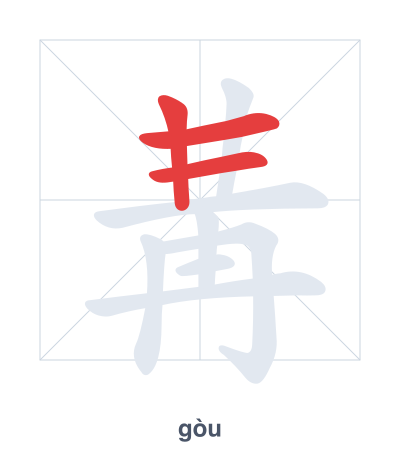
Open Hanzi Writer to see the animated stroke order and practice writing 冓 with real-time feedback.
The character 冓 (gòu) is written with 10 strokes. Follow the standard Chinese stroke order: top to bottom, left to right, outside before inside. The radical 冂 is one of its key components.
Practice the correct stroke order with the Hanzi Writer app to see animated stroke-by-stroke guidance with real-time feedback.
冓 means To meet / inner room (ancient).
| Character | 冓 |
| Pinyin | gòu (gou) |
| Meaning | To meet / inner room (ancient) |
| Strokes | 10 |
| Radical | 冂 |
| Difficulty | 3.9/5 |
The character 冓 originated as a pictograph of two fish meeting head-to-head, symbolizing an encounter or union. In ancient forms, it depicted crossed lines or intersecting objects, and later extended to mean an 'inner room' as a place where people meet.
💡 Memory Tip: Imagine two fish swimming toward each other in a small inner room (冂), their heads touching to form the cross-shaped pattern of 冓.
它是构字的偏旁。
tā shì gòu zì de piān páng
It is a radical used to form characters.
这个字读作gòu。
zhè ge zì dú zuò gòu。
This character is pronounced 'gòu'.
这是一个古汉字。
zhè shì yí gè gǔ hàn zì
This is an ancient Chinese character.
Open Hanzi Writer to see the animated stroke order and practice writing 冓 with real-time feedback.
✨ Animated stroke order · Handwriting recognition · HSK-graded practice · Free to use
冓 is composed of two parts: the top is 冂 (a radical meaning 'wide' or 'open'), and the bottom is 冉 (rǎn, meaning 'gradually' or 'a cloth'). Together, they suggest a covered or enclosed space where people might meet, relating to its ancient meanings 'to meet' and 'inner room'.