冎 (guǎ) means "Bone (ancient form)" in Chinese. It has 5 strokes with the radical 冂.
Rated 2.7/5 in difficulty (moderate).
Appears in 1+ common words including 冎 (guǎ).
Hanzi Writer's stroke validation shows learners typically need 5-8 attempts to write 冎 with correct proportion and order.
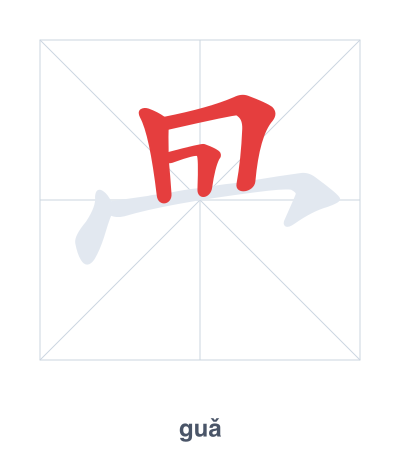
Open Hanzi Writer to see the animated stroke order and practice writing 冎 with real-time feedback.
The character 冎 (guǎ) is written with 5 strokes. Follow the standard Chinese stroke order: top to bottom, left to right, outside before inside. The radical 冂 is one of its key components.
Practice the correct stroke order with the Hanzi Writer app to see animated stroke-by-stroke guidance with real-time feedback.
冎 means Bone (ancient form).
| Character | 冎 |
| Pinyin | guǎ (gua) |
| Meaning | Bone (ancient form) |
| Strokes | 5 |
| Radical | 冂 |
| Difficulty | 2.7/5 |
This character is a pictograph of a bone, depicting the shape of a long bone with knobby joints at either end. In oracle bone script, it clearly shows a bone with two rounded heads and a straight shaft, representing the ancient form that later became the top part of 骨 (bone).
💡 Memory Tip: Imagine a single bone (冎) lying on the ground, with the top and bottom bumps representing the knobby ends and the straight line in between as the shaft.
这是一个生僻字。
zhè shì yí gè shēng pì zì
This is a rare character.
它是骨字的部首。
tā shì gǔ zì de bù shǒu
It is the radical of the character 'Gu' (bone).
这个字很少见。
zhè ge zì hěn shǎo jiàn
This character is very rare.
Open Hanzi Writer to see the animated stroke order and practice writing 冎 with real-time feedback.
✨ Animated stroke order · Handwriting recognition · HSK-graded practice · Free to use
冎 is composed of the radical 冂 (enclosure) with two horizontal strokes inside. This shape resembles a bone with a top cap and a middle section, reflecting its ancient meaning of 'bone'. The enclosure represents the marrow cavity while the strokes suggest the ends of a bone.